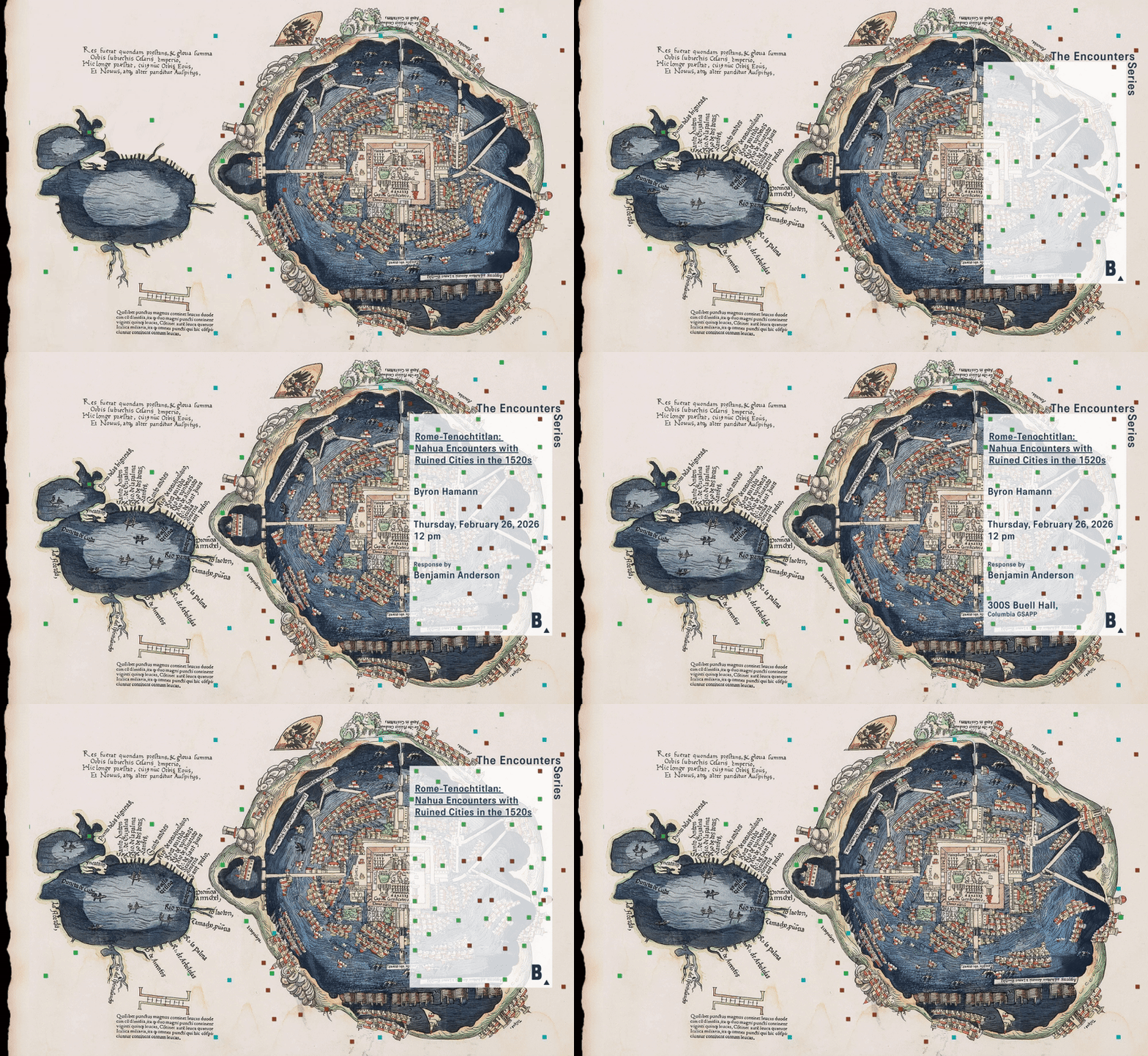
 Design: Levan Kiladze
What happens when you detach the study of American architecture (the Buell Center’s founding mission) from the inherited temporalities of United States national history, periodized, as it tends to be, by the fundamental rupture of the American Revolution? What phenomena help us think of the built environment in the Americas germinating across vaster territories and wider spans of time? One answer emerges from literature that shows architecture as a stage for and product of a long series of encounters. These moments, when radically different cultures and practices have regularly come into contact, sometimes violently, have always included the transmission of architectural knowledge. The Buell’s Encounters Series hosts speakers who tell stories, both historical and contemporary, that have shaped American built environments, in order to learn how building cultures, divisions of space, dwelling practices and other aspects of architectural discourse have been exchanged, incorporated, transformed, and retained during a long history of American encounters.
“Rome-Tenochtitlán: Nahua Encounters with Ruined Cities in the 1520s”
February 26, 2026, 12 pm EST
300S Buell Hall and online
Byron Hamann
A response by Benjamin Anderson (Cornell)
For the first event in the series, Byron Hamann, a scholar of art and writing in pre-Hispanic Mesoamerica and its links to Europe, will present new research on the voyage of four Nahua representatives—Indigenous Central Mexicans—who traveled to Rome in 1529. Their encounter with the Roman ruinscape, then undergoing reconstruction after the sack of 1527, recalled the familiar and recent destruction of another sacred city at home, Tenochtitlán, and thus shaped a new imagination and shared understanding of building and ruination.
Speaker's bio:
Byron Ellsworth Hamann received a dual PhD in Anthropology and History from the University of Chicago. His research focuses on art and writing in pre-Hispanic Mesoamerica and the connections linking the Americas and Europe in the early modern Mediterratlantic world. An editor emeritus of Grey Room, he is author of The Translations of Nebrija: Language, Culture, and Circulation in the Early Modern World (2015); Bad Christians, New Spains: Muslims, Catholics, and Native Americans in a Mediterratlantic World (2020); The Invention of the Colonial Americas Data, Architecture, and the Archive of the Indies 1781–1844 (2022); the just-drafted At the Butterfly House: Nahua Ambassadors in the Ruins of Rome, 1529; and coeditor (with Felipe Rojas and Benjamin Anderson) of Otros pasados: Ontologías alternativas y el estudo de lo que ha sido (2022).
Benjamin Anderson is Associate Professor of History of Art and Classics at Cornell University. He is author of Cosmos and Community in Early Medieval Art (2017), and co-editor of Antiquarianisms (2017), The Byzantine Neighbourhood (2022), Otros pasados (2022), Is Byzantine Studies a Colonialist Discipline? (2023), and Hagia Sophia in the Long Nineteenth Century (2024). His edition of Robert Wood’s Ruins of Palmyra and Baalbek appeared in 2021. During 2025/26, he is a Faculty Fellow at the Society for the Humanities.