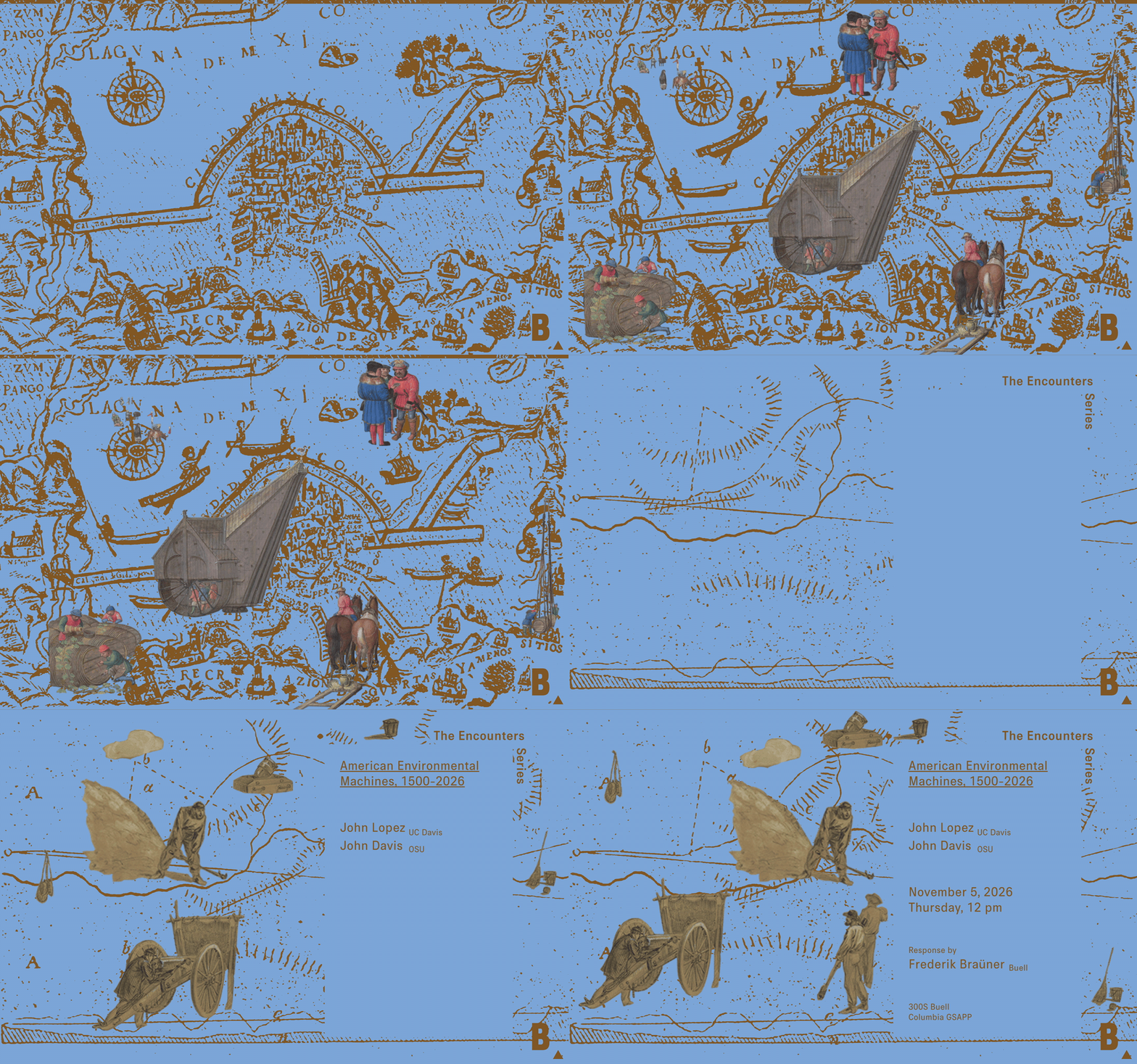
Design: Levan Kiladze
The Encounters Series: “American Environmental Machines, 1500-2026”
November 5, 2026, 12 pm EST
300S Buell Hall and online
John Lopez (UC Davis)
John Davis (OSU)
A response by Frederik Braüner (Buell Fellow)
Human efforts to engineer ecologies and landscapes in the Americas have long required massive amounts of labor and machinery. John López tracks the import of Dutch flood-control techniques to Renaissance Mexico City, where they faced the aquatic consciousness of Aztec Tenochtitlán. John Davis uncovers an unrealized project to redesign the American landscape after Reconstruction, leveraging the US Army Corps of Engineers to produce the largest ever swath of agricultural land reclaimed for freedpeople. Frederik Braüner will give a response.
For in-person attendance (general public welcome), complete this form to RSVP. If you do not have an active Columbia ID card, please RSVP before noon on Monday November 2 - you will receive an email from Columbia University Public Safety containing a QR code, which you will be asked to present along with a matching ID at campus gates. Please allow a few extra minutes to pass through campus security. Please note: 300S Buell Hall is reached by three flights of stairs; there is no elevator in the building.
For virtual attendance, register for the webinar here.
Speakers:
John López is Associate Professor of Art History at the University of California, Davis. López’s research takes a comparative and interdisciplinary approach to examining the visual, material, and spatial practices between early modern Europe and the New World. López earned a Ph.D. from the History, Theory, and Criticism of Architecture and Art program at MIT and was a postdoctoral scholar at the University of Chicago. His latest book, The Aquatic Metropolis, examines the centuries-old efforts by the Aztec and Spanish to end catastrophic inundation at Mexico City via image making, urban planning, and environmental change.
John Davis is an environmental and architectural historian and assistant professor at the Knowlton School (OSU). His primary research area is on technology, construction, and environment in the Americas in the modern era. He holds a B.S. from the University of Virginia, and an M.Arch. and Ph.D. from Harvard University. Davis’s current book project is about military and civil engineering and environment in the U.S. South after the American Civil War, examining the physical processes of building that undergirded the central political metaphor of the Reconstruction Era.
Frederik Braüner is an architect, editor, and historian of modern and contemporary architecture. His research focuses on the overlapping histories of colonialism, welfare ideologies, and high-modernist spatial practices, particularly in the Arctic and the broader Circumpolar North. Braüner holds a PhD in Architecture with a designated emphasis in European and Scandinavian Studies from the University of California, Berkeley; an MA in Political Architecture from the Royal Danish Academy; and a BA in Art History from the University of Copenhagen. He is the 2026-2028 Buell Center Research & Teaching Fellow.