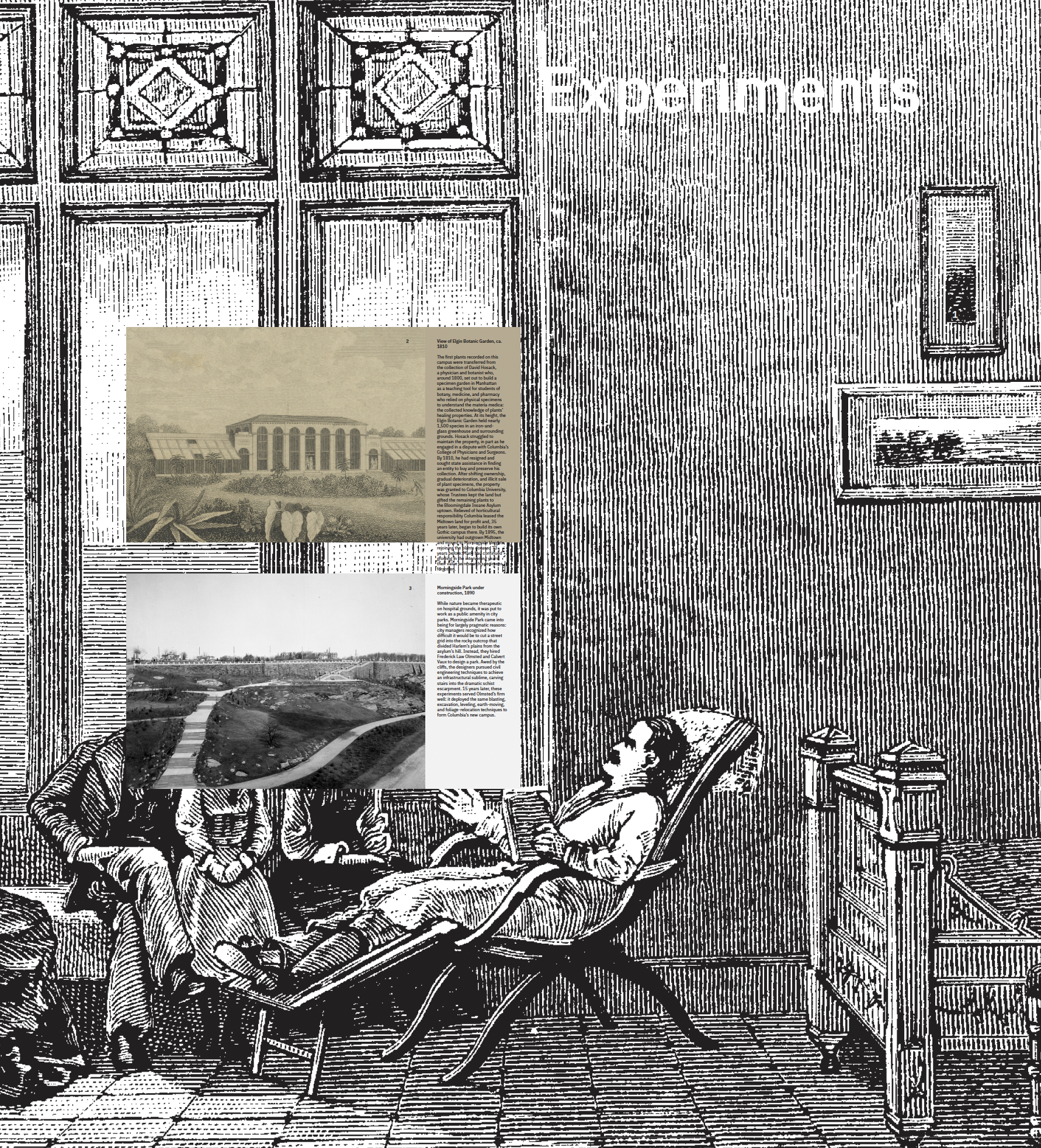
Private room at the New York Hospital, Harper’s New Monthly Magazine 57 (July 1878)
Experiments
The last 150 years of this site’s history have been marked by an experimental attitude derived from the natural and social sciences. Its built experiments – often channeled through New York’s elite social circles – have defined the scale of the campus’s architectural experience and the tenor of its landscape.
By the middle of the 19th Century, private residential hospitals were becoming popular in the United States, supplanting home care and expanding services offered by public facilities. In place of corridors lined with beds, patients were offered parquet floors and carved wooden furniture in private apartments, where they were served by staff and visited by family.
In 1886, the Bloomingdale Insane Asylum experimented with this model of care, using a donation from the Society of New York Hospital’s treasurer, William H. Macy, to build a standalone pavilion. Under a slate mansard roof and surrounded by generous porches, the brick-walled “Macy Villa” contained four suites per floor, each with a fireplace and landscape views. This model offered a double economic advantage: “the close quarters of a family environment” would attract more affluent patients, while “the smaller size of the structure” would reduce building costs.”
The experiment was thus not only in psychiatric care, but also in institutional management and financing. The New York Hospital was the first founded as a public hospital in the colony, and among the first three in what would, a decade later, become the United States. Public hospitals required profits, tax breaks, and donations to sustain and grow their operations. This growth was achieved through multiple rounds of land grants and philanthropy, and also by chance inheritance.
View of Elgin Botanic Garden, 1810
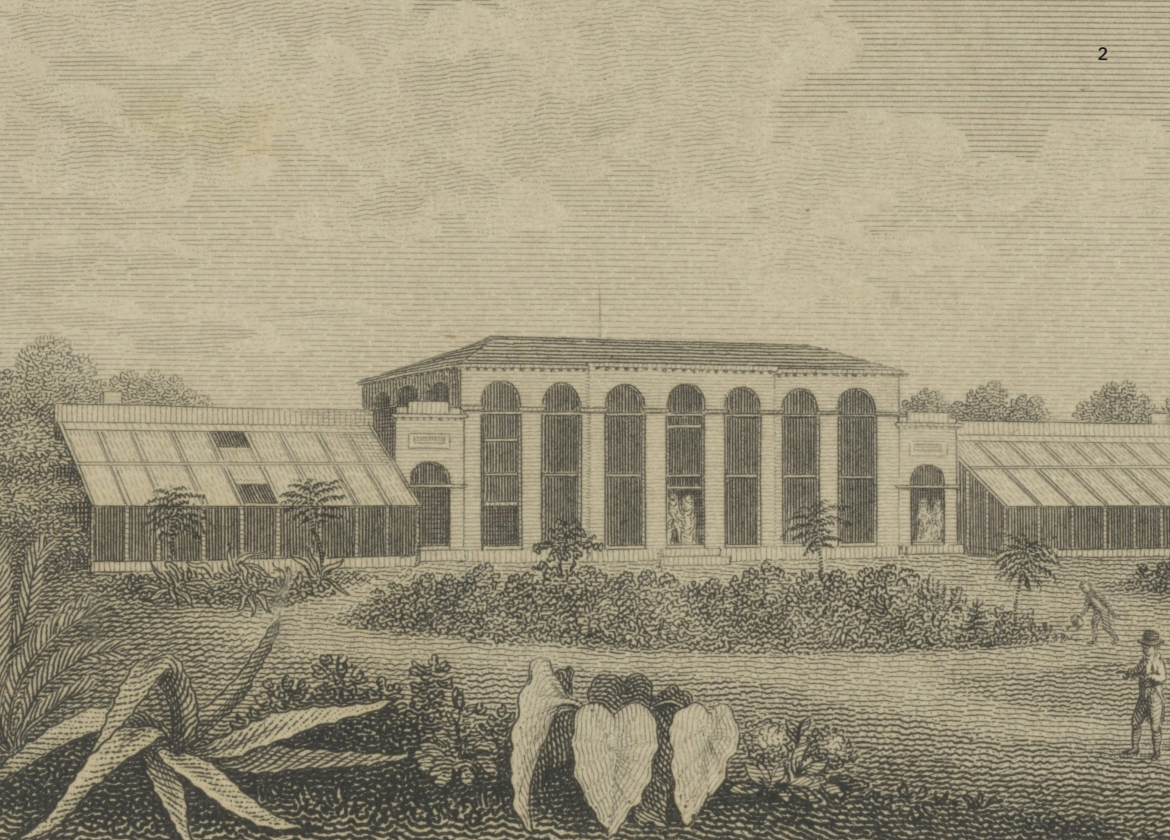
G W.S. Leney, “View of Elgin Botanic Garden” (ca. 1810), Eno Collection of New York City Views, Wallach Division, New York Public Library
The first plants ever recorded on this campus were transferred from the collection of David Hosack, a physician who, around 1800, set out to build a specimen garden as a teaching tool. Students of botany, medicine, and pharmacy used physical samples to learn the materia medica: plants’ healing properties. At its height, the Garden contained nearly 1,500 species in an iron-and-glass greenhouse and surrounding grounds.
Yet, Hosack struggled to maintain the property, and after deterioration and illicit specimens sales, the State granted it to Columbia, whose Trustees kept the Midtown land but gifted remaining plants to the Bloomingdale Insane Asylum uptown. Relieved of horticultural responsibility, Columbia leased the site for profit until 35 years later, when it built a new campus there. By 1895, the university had outgrown this campus too, and moved uptown to replace the Bloomingdale Asylum, rejoining the plants donated 73 years before. Many had continued growing, their value as research specimens forgotten.
Morningside Park under construction, 1890
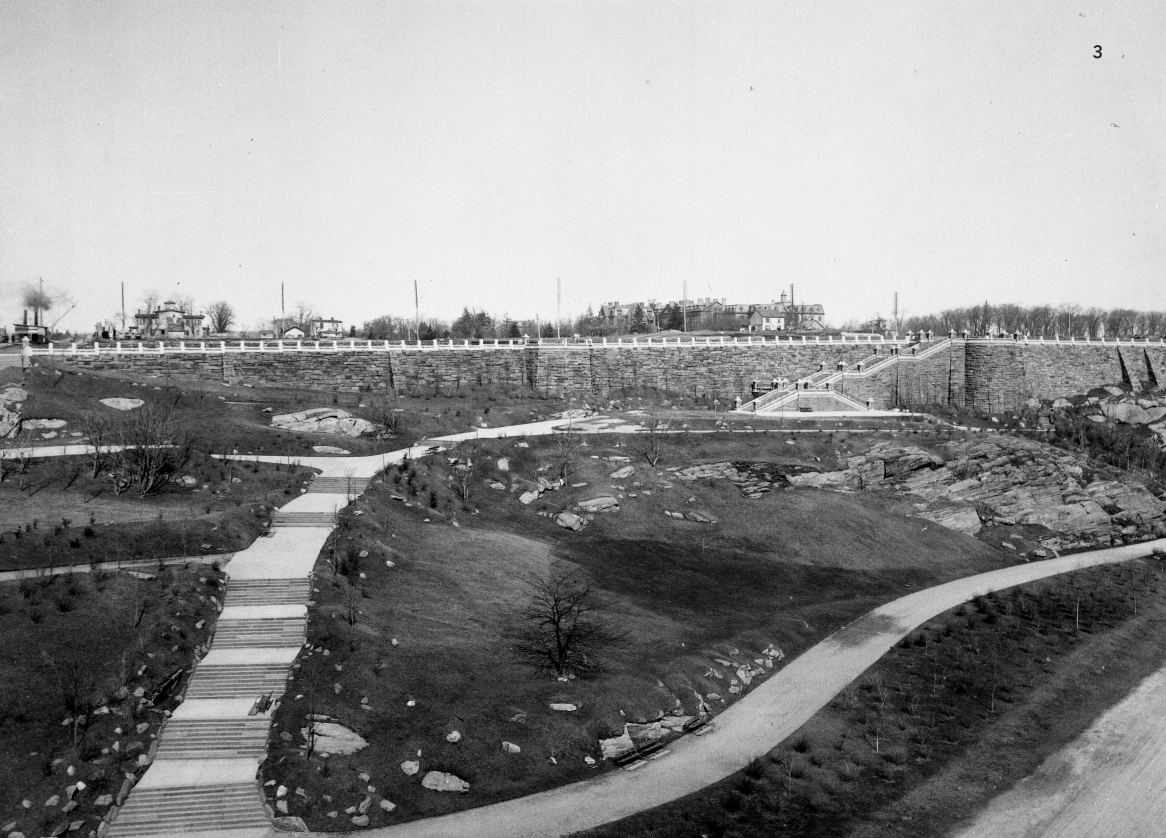
Morningside Park under construction (1890), Columbiana Collection, Columbia University Archives
While nature became therapeutic on hospital grounds, it was put to work as a public amenity in city parks. Morningside Park came into being for largely pragmatic reasons: city managers recognized how difficult it would be to cut a street grid into the rocky outcrop that divided Harlem’s plains from the asylum’s hill. Instead, they hired Frederick Law Olmsted and Calvert Vaux to design a park.
Awed by the cliffs, the designers pursued civil engineering techniques to achieve an infrastructural sublime, carving stairs into the dramatic schist escarpment. 15 years later, these experiments served Olmsted’s firm well: it deployed the same blasting, excavation, leveling, earth-moving, and foliage-relocation techniques to form Columbia’s new campus.