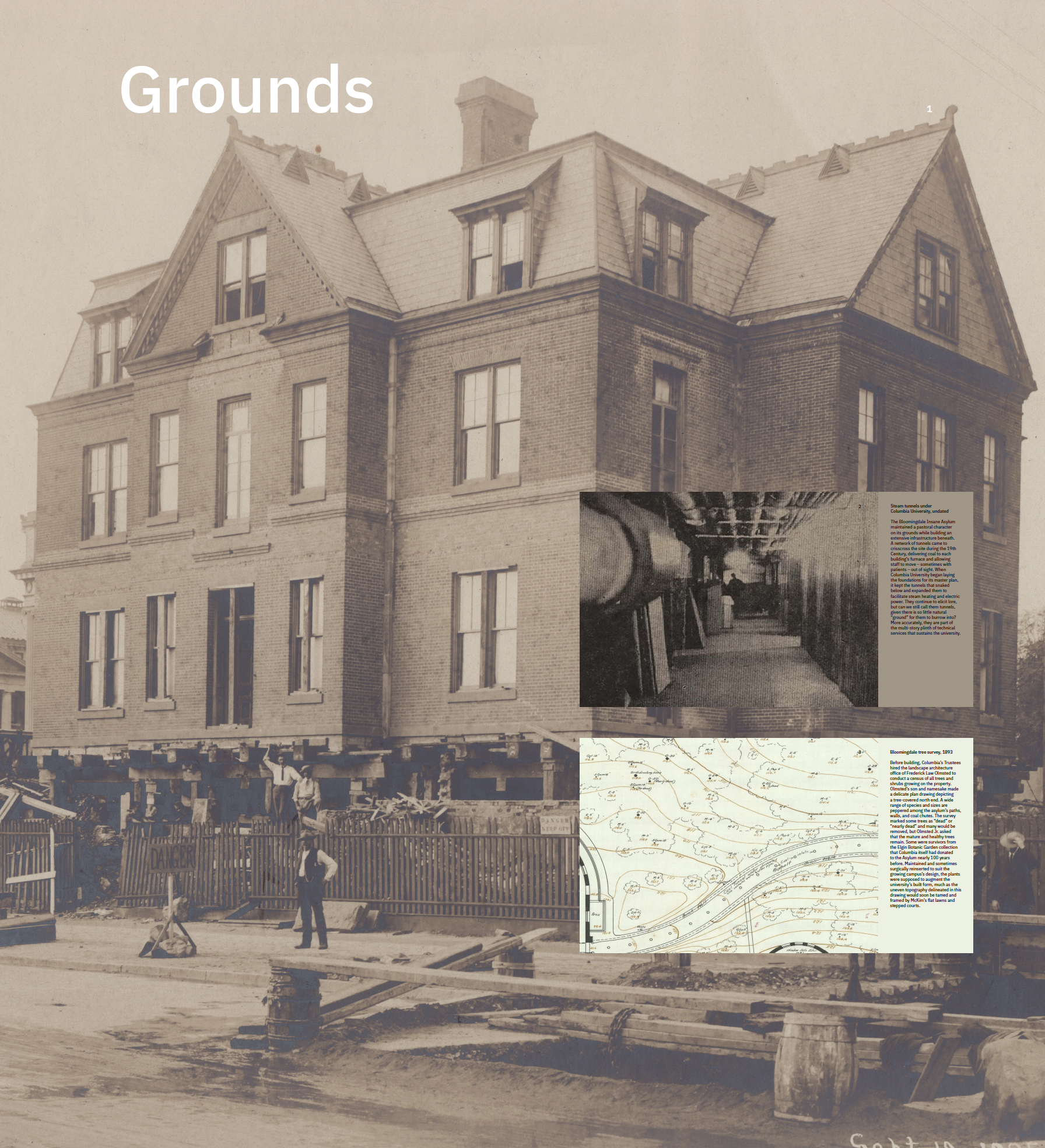
College Hall moves closer to Low Library, September 19, 1905. Photograph. From Columbia University Archives, Historical Photograph Collection, scan 2126.
Grounds
Columbia arrived in Upper Manhattan during a period of intense investment in the city’s infrastructure. The university borrowed a steady stream of inventions and adaptations from public works to create a sophisticated campus. It grafted itself onto the rocky “plinth,” plugging into the asylum’s existing tunnels and cloaking the latest service networks (electric lighting, indoor plumbing) behind serene neoclassical façades. It was a process marked by continuous selection, curation, survivals, and continuances.
Buell Hall is the only Bloomingdale building to survive almost intact on Columbia’s campus. No archival document exists where trustees or architects mandated its preservation; in fact, all master plans show the building gone. There is plentiful evidence for its continued salvage, however. Even as the asylum’s buildings were razed one by one; even as the main building’s bricks were auctioned off, Buell Hall survived.
First, the villa was strategically useful. When the Trustees hired Charles McKim to design a master plan, the architect devised a modular scheme so construction could be sequenced: work on new buildings could begin immediately while asylum buildings remained, some of them occupied temporarily by classes and other activities. This phasing helped the new campus open to students as early as 1895.
Second, Buell Hall survived in part because it could accommodate the less monumental functions needed for constructing – and later, managing – the vast campus of a modern mass university. Even when this small building encroached on the master plan, it could be moved. Compared to the university’s massive new stone-and-steel halls, the former villa was light and transportable. As shown in this photograph, it was lifted off its foundations and slid along soaped wooden planks, losing its porches to become a cubic volume.
Lastly, with its image of genteel domesticity, Buell Hall undoubtedly began to seem picturesque and thus historically valuable as the years went on, its small scale softening the grand symmetry of the Beaux-Arts campus, and its eclectic historicism sitting well with the university chapel nearby.
Steam tunnels under Columbia University, undated
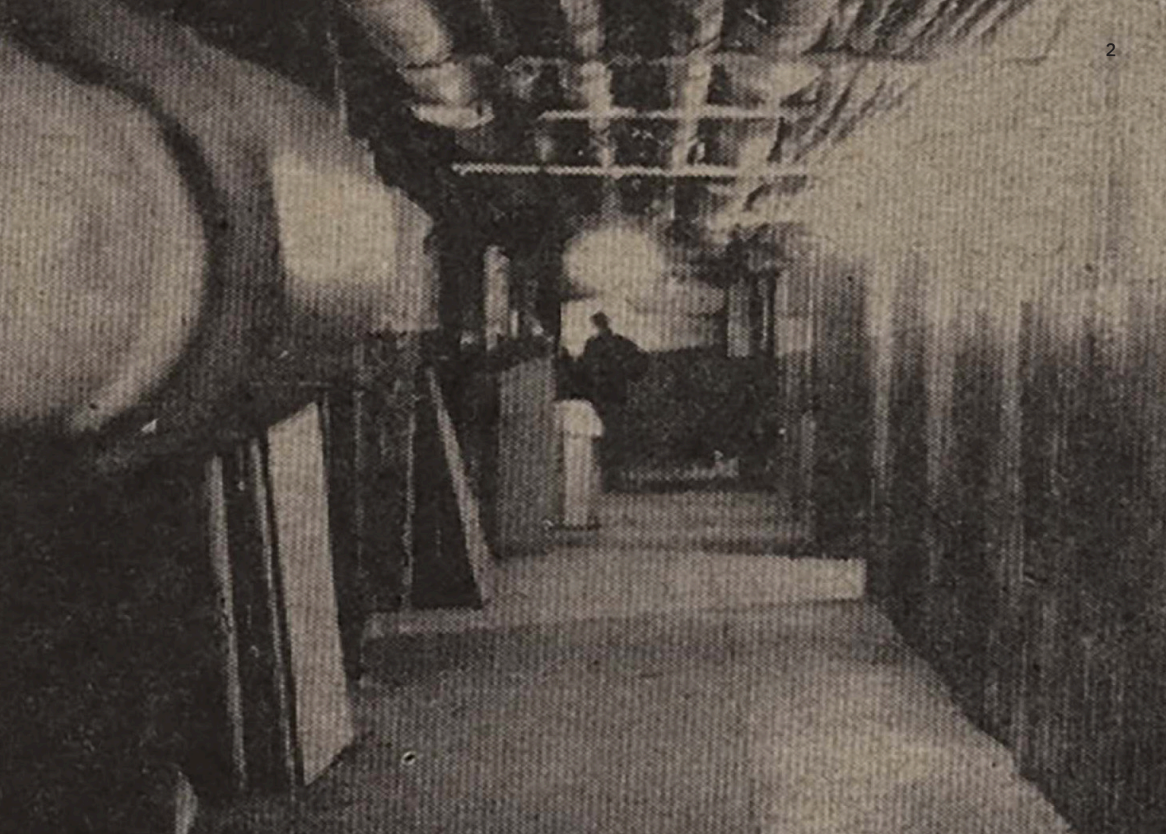
Steam tunnels under Columbia University, undated, source unknown
The Bloomingdale Insane Asylum maintained a pastoral character on its grounds while building an extensive infrastructure beneath. A network of tunnels came to crisscross the site during the 19th Century, delivering coal to each building’s furnace and allowing staff to move – sometimes with patients – out of sight.
When Columbia University began laying the foundations for its master plan, it kept the tunnels that snaked below and expanded them to facilitate steam heating and electric power. They continue to elicit lore, but can we still call them tunnels, given there is so little natural “ground” for them to burrow into? More accurately, they are part of the multi-story plinth of technical services that sustains the university.
Bloomingdale tree survey, 1893
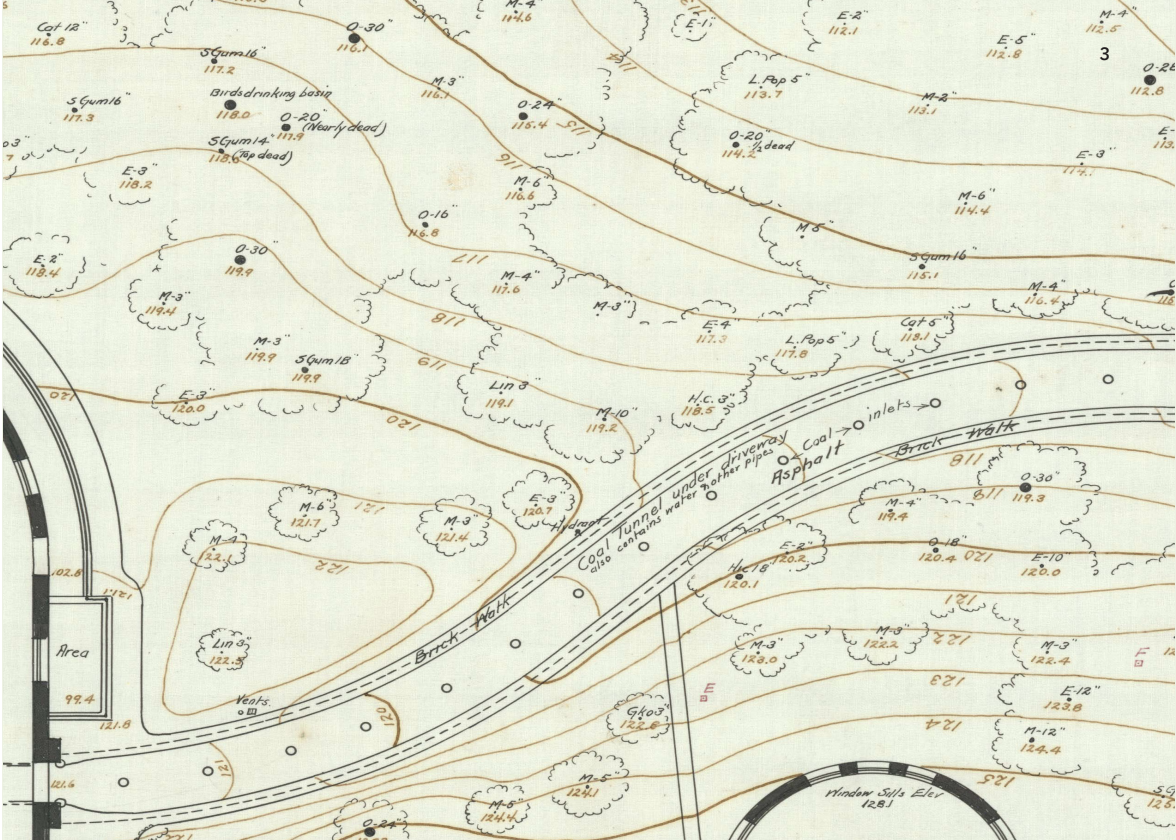
Frederick Law Olmsted, “Columbia University, Northerly Portion of Grounds” (1893), Library of Congress
Before building, Columbia’s Trustees hired the landscape architecture office of Frederick Law Olmsted to conduct a census of all trees and shrubs growing on the property. Olmsted’s son and namesake made a delicate plan drawing depicting a tree-covered north end. A wide range of species and sizes are peppered among the asylum’s paths, walls, and coal chutes.
The survey marked some trees as “dead” or “nearly dead” and many would be removed, but Olmsted Jr. asked that the mature and healthy trees remain. Some were survivors from the Elgin Botanic Garden collection that Columbia itself had donated to the asylum 73 years before. Maintained and sometimes surgically reinserted to suit the growing campus’s design, the plants were supposed to augment the university’s built form, much as the uneven topography delineated in this drawing would soon be tamed and framed by McKim’s flat lawns and stepped courts.