The biennial Dissertation Colloquium brings together a select group of doctoral students from diverse institutional and disciplinary backgrounds working on dissertation topics related to the history, theory, and criticism of American architecture, urbanism, and landscape.
The Buell Conference on the History of Architecture brings together scholars in architectural and urban history to discuss topics in architecture, urbanism, and modernity as broadly understood.
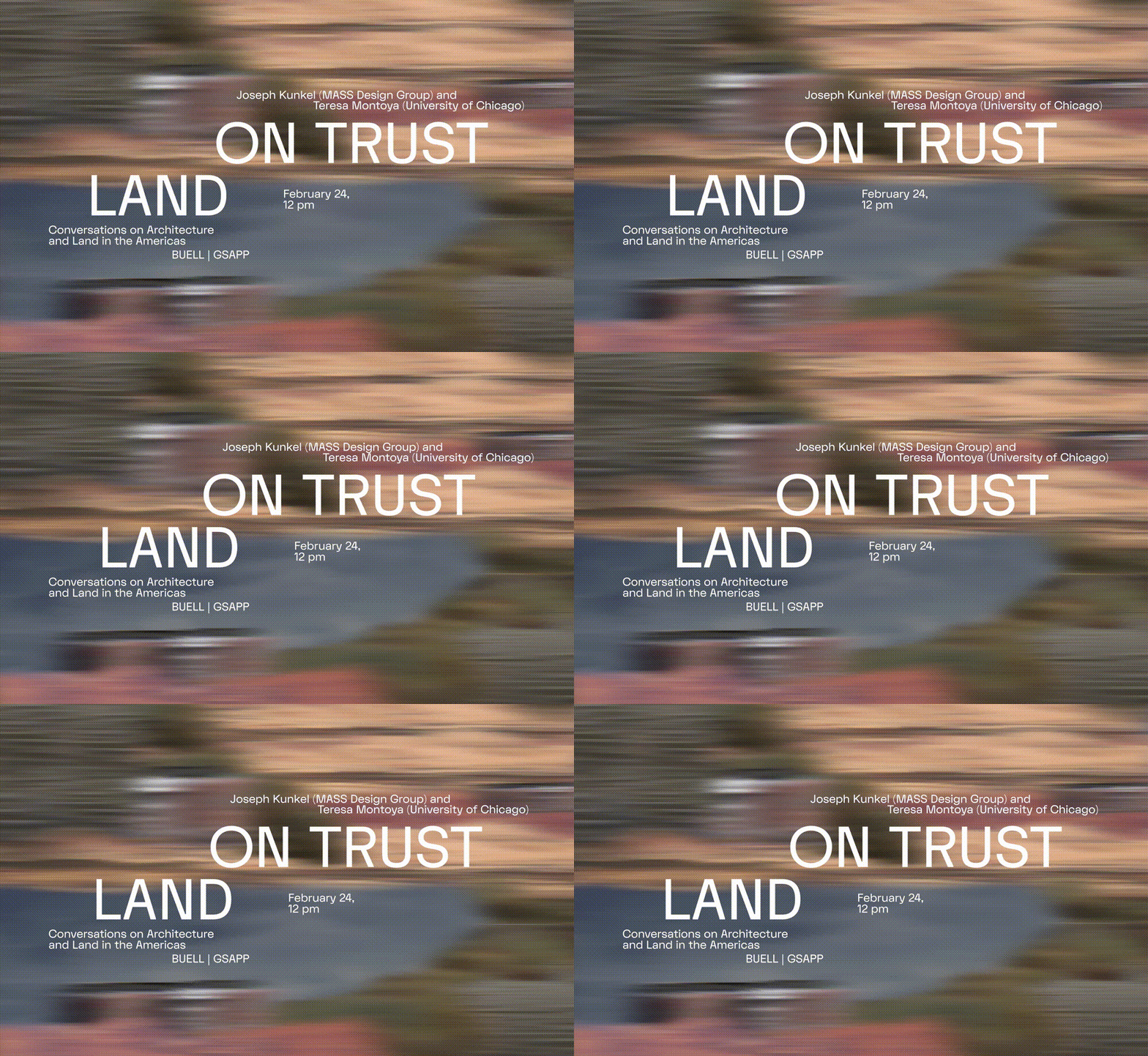
A conversation between Joseph Kunkel (Director, Sustainable Native Communities Design Lab at MASS Design Group) and Teresa Montoya (Assistant Professor of Anthropology at the University of Chicago)
Joseph Kunkel, a citizen of the Northern Cheyenne Nation, is a Principal at MASS Design Group, where he directs the Sustainable Native Communities Design Lab in Santa Fe, New Mexico. He is a community designer and educator, focused on sustainable development practices throughout Indian Country. His work includes exemplary American Indian housing projects and processes nationwide. This research work has developed into emerging best practices, leading to an online Healthy Homes Road Map for Tribal housing development, funded by HUD’s PD&R Office. In 2019 Joseph was awarded an Obama Foundation Fellowship for his work with Indigenous communities. Joseph is a Fellow of the inaugural class of the Civil Society Fellowship, a partnership of ADL and The Aspen Institute, and a member of the Aspen Global Leadership Network. Most recently Joseph was named a 2022 Rubinger Community Fellow by the Local Initiative Support Corporation (LISC).
Teresa Montoya is a social scientist, media maker, and educator. Montoya’s research and media production focuses on legacies of environmental contamination in relation to contemporary issues of tribal jurisdiction, regulatory politics, water security, and public health on the Navajo Nation. Her research has been published in Cultural Anthropology, Water International, the American Journal of Public Health, and the Journal for the Anthropology of North America. Her photographic and film work has been shown internationally, most recently in an exhibition entitled Spill in Vancouver, B.C. In addition to her art practice, she has curatorial and education experience in various institutions, including the Peabody Essex Museum, the National Museum of the American Indian, and currently the Field Museum. She is a Provost’s Postdoctoral Fellow and incoming Assistant Professor in the Department of Anthropology at the University of Chicago. She is Diné and an enrolled member of the Navajo Nation.
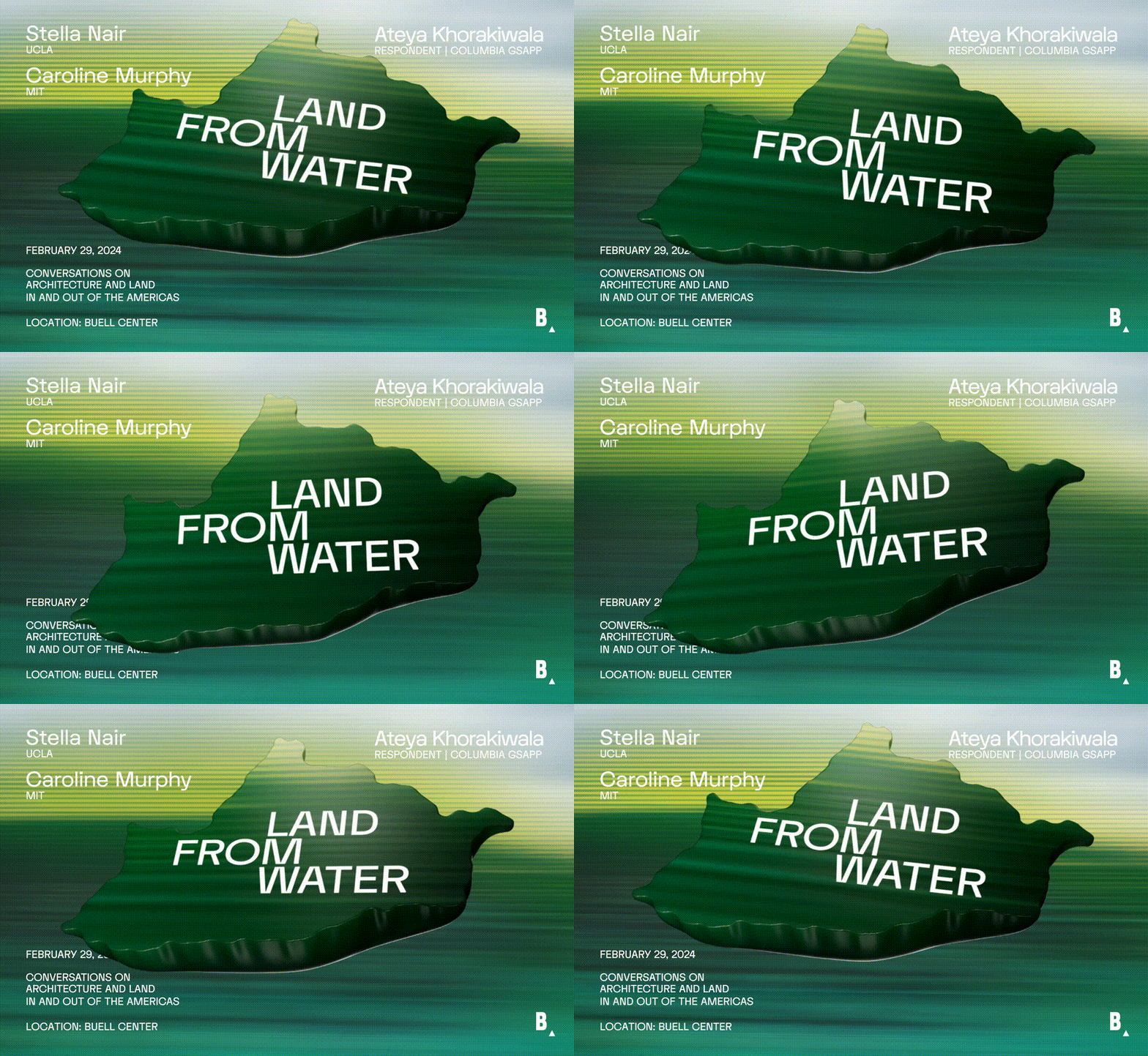
February 29, 2024; 12 pm (noon) 300S Buell Hall and online
Inca rulers and Italian Renaissance political thinkers shared a peculiar commonality: they thought of land as an infrastructure that could be shaped to direct the flows of water and wealth. Stella Nair and Caroline Murphy, historians of the early-modern period, will present research about land management techniques drawn from the long history of infrastructure in two globally distant 16th-century places: Cuzco, Peru, and Tuscany, Italy.
Speakers:
Caroline E. Murphy is an Assistant Professor in the History, Theory, and Criticism of Architecture and Art section of the Department of Architecture at MIT. Her research and teaching explore the interconnected material and intellectual histories of environmental engineering, state administration, and political economy in early modern Europe and its global contact zones. Her current book project, which focuses on alluvial design and planning in Italy on the eve of the Little Ice Age, examines how the peninsula’s consolidating principalities, primarily Tuscany, worked to transform landscapes of unruly rivers into viable communication infrastructures, both to mitigate flood disasters and partake of the fruits of early globalization. Caroline’s work has been supported by fellowships from MIT, the Graham Foundation for Advanced Studies in the Visual Arts, the Kunsthistorisches Institut in Florenz – Max-Planck-Institut, and the Social Sciences and Humanities Research Council of Canada. She has taught in the Department of History at Villanova University, and holds a PhD in History, Theory, and Criticism of Architecture and Art from MIT.
Stella Nair’s scholarship focuses on the built environment of Indigenous communities in the Americas and is shaped by her interests in spatial practices, cultural landscapes, aural and ephemeral architecture, gender studies, construction technology, and hemispheric networks. Trained as an architect and architectural historian, Nair has conducted fieldwork in Bolivia, Mexico, Peru, and the United States, with ongoing projects in the South Central Andes. She has published two books. The first book, At Home with the Sapa Inca: Architecture, Space, and Legacy at Chinchero (University of Texas, 2015), examines the sophisticated ways in which the Inca manipulated space and architecture to impose their authority. The second book, (with Jean-Pierre Protzen) The Stones of Tiahuanaco: A Study of Architecture and Construction (Cotsen Institute of Archaeology Press, 2013), explores one of the world’s most artful and sophisticated carving traditions. Nair is currently a Fellow at the National Humanities Center and has received numerous research grants and fellowships, such as from the American Academy of Rome, the American Philosophical Association, the Center for the Study of the Visual Arts (National Gallery of Art), Dumbarton Oaks, the Fulbright Institute, the Getty Foundation, the Guggenheim Foundation, the John Carter Brown Library and the Terra Foundation for American Art.
Ateya Khorakiwala is an architectural historian and is Assistant Professor of Architecture at Columbia University GSAPP. Her research focuses on India’s development decades. The work examines the aesthetics and materiality of its postcolonial infrastructure and ecological and political landscapes. Her current book project Famine Landscapes, is an infrastructural and architectural history set in India’s postcolonial countryside. The book shows how infrastructures of the developmental decades can be traced back to colonial famine policies, physiocratic theories of land management, and utilitarian theories of governance, even as these architectural interventions emerge in a contested field of cold war techno-scientific thinking. Other research projects include the labor politics and environmental histories of architectural materials like concrete, bamboo, and plastic. Khorakiwala’s essays and articles have appeared in e-flux Architecture, Comparative Studies of South Asia, Africa and the Middle East (CSSAAME), Grey Room, and the Journal of Architectural Education (JAE). She co-edited Architecture in Development: Systems and the Emergence of the Global South (Routledge, 2022). Khorakiwala received her Ph.D. from Harvard University her MS in Architecture Studies from MIT, and was trained as an architect at KRVIA in Mumbai, India.