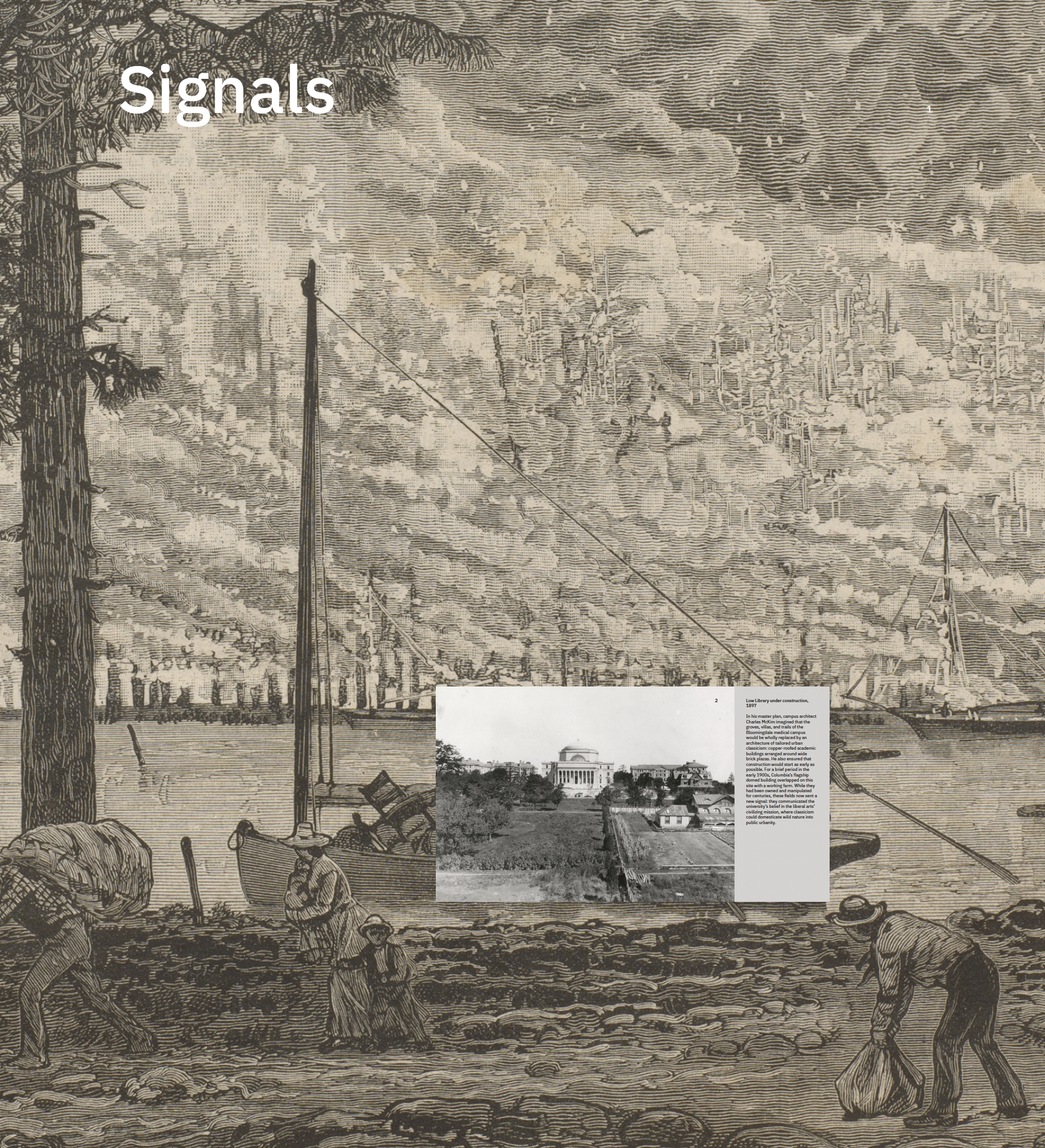
James Darby, “A scene on oyster creek during the recent fire in the pine and cedar forests” in Frank Leslie’s Illustrated Newspaper 50 no. 1287 (29 May 1880)
Signals
All modern building cultures are prefigured by messages, through which communities stake a claim to belonging. Manhattan is no different.
The first written record of the word “Manahatta” appears in the diary of Robert Juet, a crewman aboard a ship chartered by the East India Company to map what came to be known as the Hudson River. As they sailed through the harbor, Juet wrote the crew “saw a great Fire, but could not see the land.”1 The timing of this mention, in early September, suggests the glowing flame and billowing smoke Juet saw were products of Indigenous land management developed here over millennia. Like many Indigenous homelands, Lenapehoking was tended by fire. Seasonal controlled burns maintained succession landscapes abundant with food to sustain humans and their animal counterparts.
The Lenni-Lenape and other Indigenous nations, including the Wappinger, Mohawk, and Wampanoag, convened in the area of Manhattan now called Astor Place (among others) to negotiate the region’s stewardship, visit, and celebrate. They passed seasonally through sites according to cycles that included hunting, fishing, shaping landscapes, and signalling these changes with flames on the horizon. They continued to steward the land freely until about a generation after the Dutch appeared in Lower Manhattan.
The Europeans who dispossessed the Lenape through attacks and enclosure also used their labor to signal their intent to settle. As the bottom of this engraving shows, they channeled streams into canals, dug wells to reach aquifers beneath forests and marshlands, and allotted and tilled the land. Colonists employed the concept of “improvement” to explain these works, justifying them through the promise of economic output. In fact, this new kind of agriculture narrowed the range by which land’s productivity could be evaluated. The soil’s increasing dedication to monoculture impoverished it, and required constant cultural reinforcement to maintain settler confidence in how land could be capitalized: how it would, eventually, pay them back for their hardscrabble existence in an unwelcoming place.
Low Library under construction, 1897
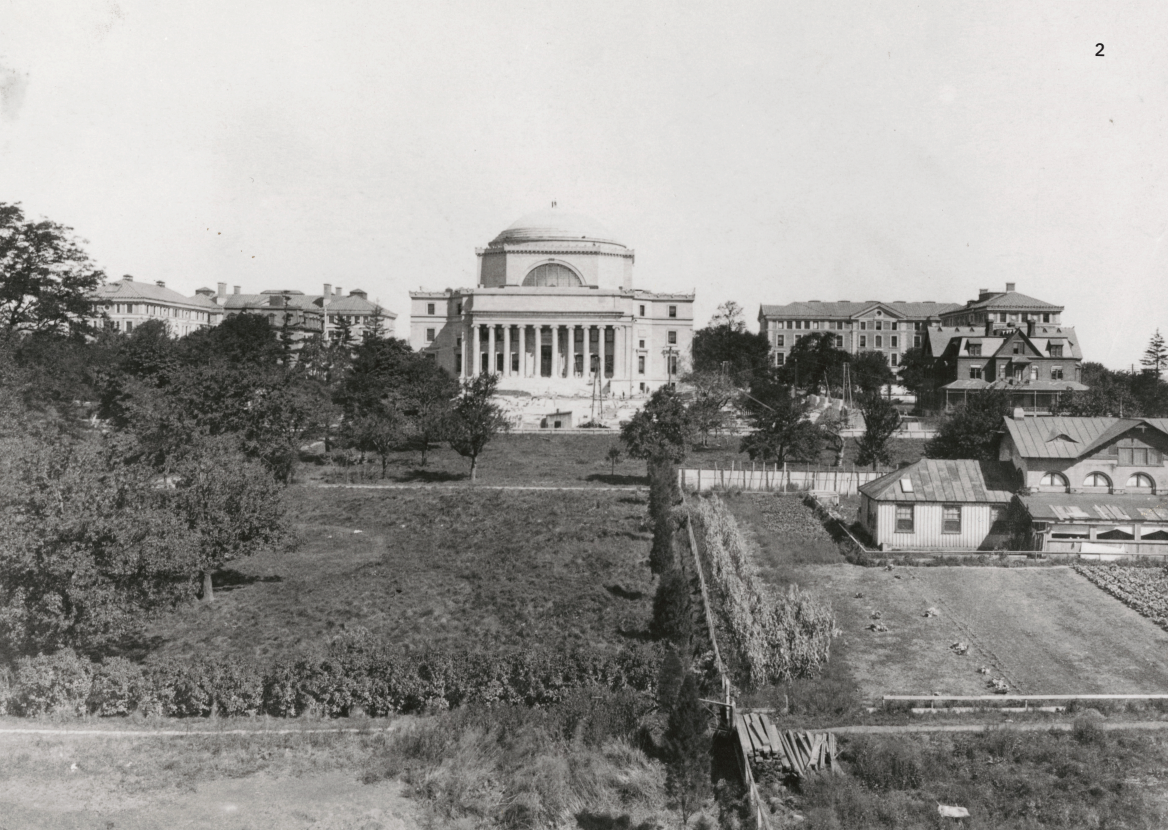
Low Library completed in front of a working farm (1897), Columbiana Collection, Columbia University Archives
Campus architect Charles McKim imagined that the groves, villas, and trails of the Bloomingdale medical campus would be wholly replaced by an architecture of tailored urban classicism. His master plan was full of copper-roofed academic buildings arranged around wide brick plazas. He also ensured that construction would start as early as possible.
For a brief period in the early 1900s, Columbia’s flagship domed building overlapped on this site with a working farm. While they had been owned and manipulated for centuries, these fields now sent a new signal: they communicated the university’s belief in the liberal arts’ civilizing mission, where classicism could domesticate wild nature into a space for modern public life.
- 1
Juet, Robert. “Juet’s Journal of Hudson’s 1609 Voyage.” In Purchas his Pilgrimes, Samel Purchas, ed., London, 1625. Transcribed by the New York Times, https://www.nytimes.com/interactive/projects/documents/robert-juet-s-journal-of-hudson-s-1609-voyage