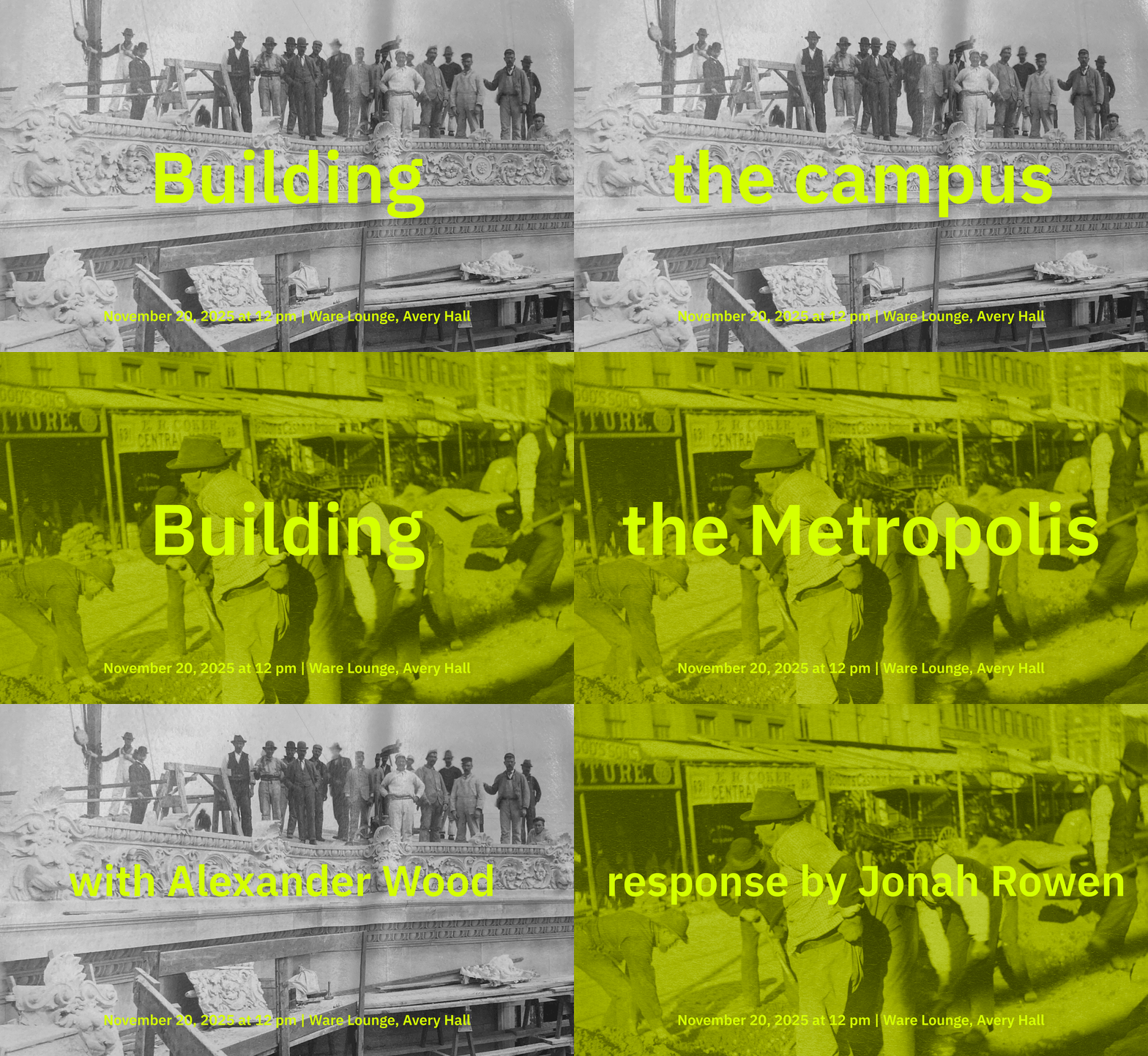
The biennial Dissertation Colloquium brings together a select group of doctoral students from diverse institutional and disciplinary backgrounds working on dissertation topics related to the history, theory, and criticism of American architecture, urbanism, and landscape. 

The Buell Conference on the History of Architecture brings together scholars in architectural and urban history to discuss topics in architecture, urbanism, and modernity as broadly understood.

Before you were here
Image


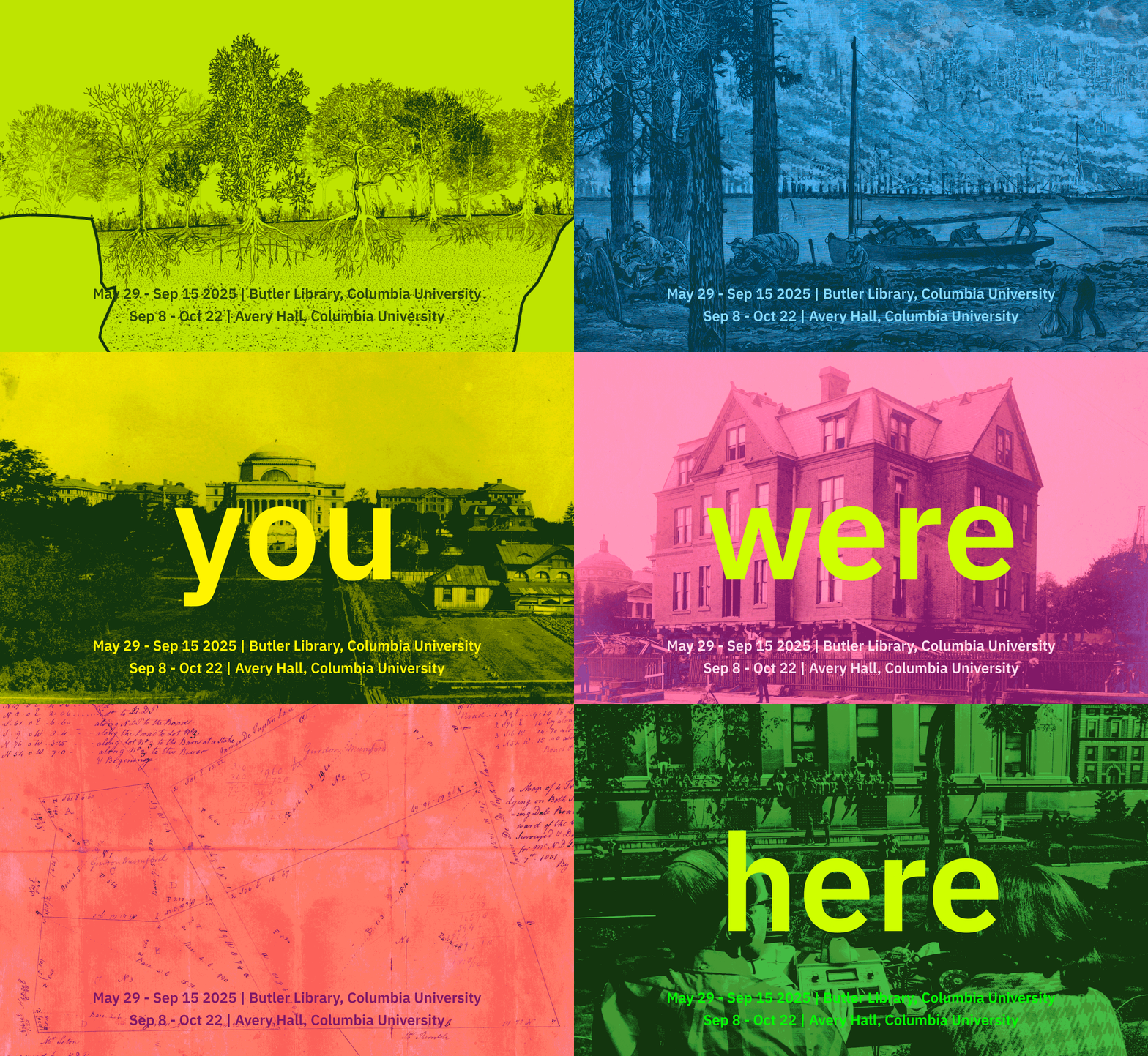
Before you were here: A history of the campus’s land, as told from its oldest surviving building
 

Despite all appearances, a campus is not a place. Although its status and self-similar architecture convey a unified image, the university is not confined to a particular patch – or even a series of main and satellite campuses – but rather exists and exerts power by means of several techniques. The university is operationalized through architecture, real estate, and more experimental tools. 

Campus histories are usually told from the school’s semi-mythic founding and remain, floating, high above the ground, as they recount the institution’s chain of successes and enduring qualities. Campus histories tend to be narratives of plans made and realized, of great men and scholars, of nature and culture communing in a uniquely conducive pedagogical environment.

In this exhibition, the story of the campus is told, instead, from the perspective of one spot on the campus’s land: the attic rooms that make up the Buell Center at Columbia GSAPP. From the windows of this house – the oldest remaining building here – and affected by the Center’s mission to understand the relationship of architecture and land in the Americas, this research attempts to unearth how Columbia’s campus is inscribed in a longer continuum of place-making strategies, events, and actors.

Before you were here is on view at Butler Library for its final three weeks, through September 12. The exhibition showcases a history of Columbia’s campus, as told from its oldest surviving building, Buell Hall: why was it built, then moved? What changes in the land have accompanied its remarkable survival? Based on three years of research conducted by Director Lucia Allais, the Buell team, and student researchers, the show features both archival material and new commissioned work, including an AR landscape by Sonia Sobrino Ralston. The next iteration of this exhibition will be on view in Avery Hall (200 level), September 8 - October 22. 
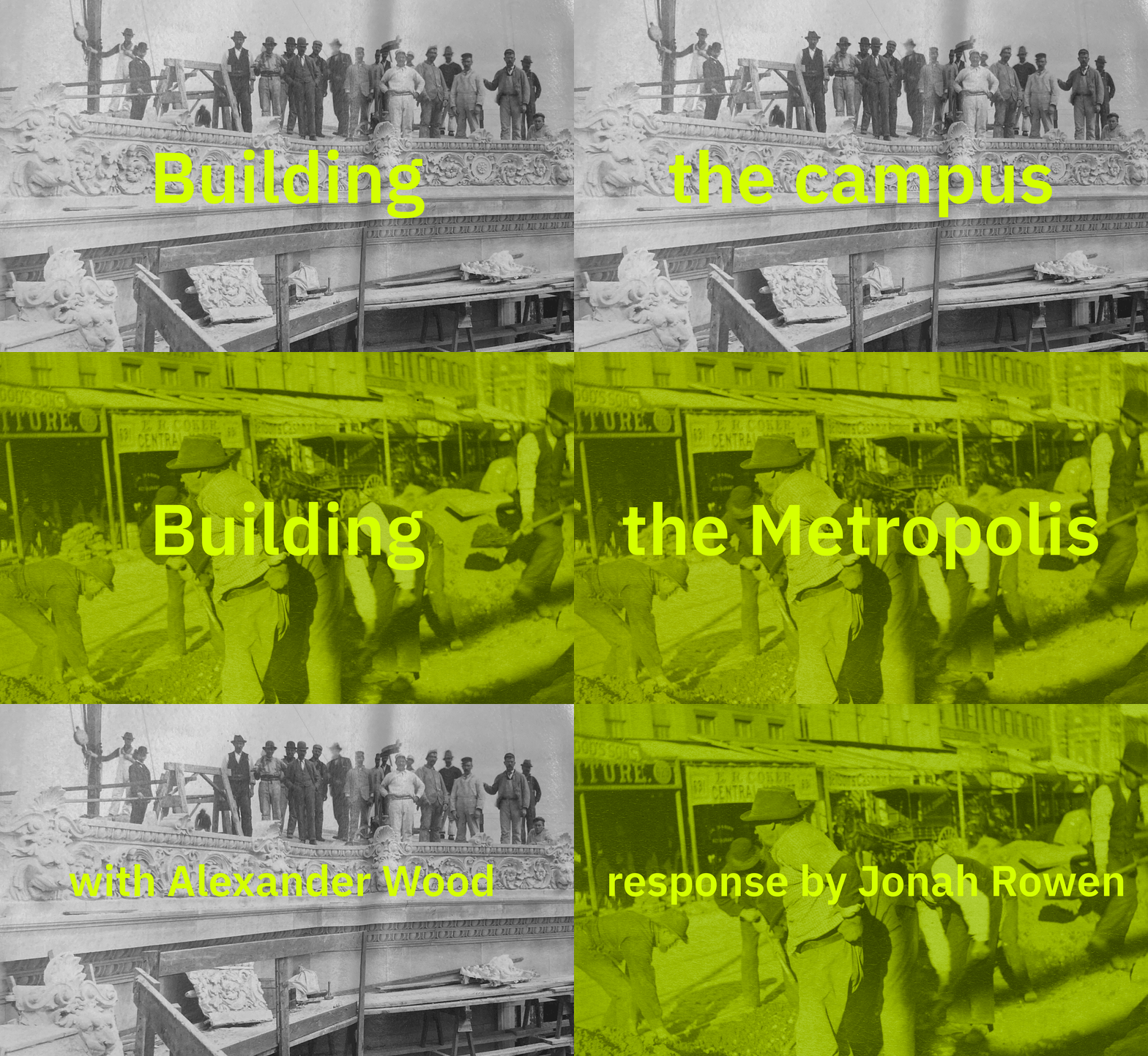


Building the Campus, Building the Metropolis: Architecture and Labor in the City
Thursday, November 20, 2025, 12:00 pm ET
Ware Lounge, Avery Hall and online

What traces of Columbia’s long architectural and labor history remain evident on its Morningside Heights campus, and in the archives contained here? This event considers the Buell Center’s exhibition Before you were here and Alexander Wood’s research featured in his recent book, Building the Metropolis: Architecture, Construction, and Labor in New York City, 1880–1935. Jonah Rowen (Vassar) will provide a response to both exhibition and book.

Speakers:

Alexander Wood is a historian of American architecture and urbanism. His published research has focused on the history of New York City and, in particular, on the history of the building industry. He is the author of Building the Metropolis: Architecture, Construction, and Labor in New York City, 1880-1935 (University of Chicago Press, 2025). His work has also been published in the Journal of the Society of Architectural Historians, Buildings & Landscapes, and other journals. In 2021-2022, he was the Helen and Robert Appel Fellow in History and Technology at the New York Historical. He received his Ph.D. from Columbia University and his B.Arch. from the Cooper Union. 

Jonah Rowen is an Assistant Professor of Architectural and Urban History at Vassar College. His work focuses on the intersections between craft, technologies, construction, economics, and environments. He devotes special attention to architectural drawings, business records, and correspondence among architects, builders, engineers, fabricators, and insurance agents. His forthcoming book is titled Architecture of Security: Building across the British Black Atlantic. He received his Ph.D. from Columbia GSAPP, M.Arch from Yale, and B.A. from Carnegie Mellon. He completed fellowships with the National Gallery, the Clark Library, and the Italian Academy for Advanced Studies at Columbia. His publications include articles in the Journal of the Society of Architectural Historians, Grey Room, and Aggregate; recent chapters in The Routledge Companion to Race and Architecture, Architectures of Extraction in the Atlantic World; and a forthcoming chapter on the history of mahogany in Rewriting the American Present.