The biennial Dissertation Colloquium brings together a select group of doctoral students from diverse institutional and disciplinary backgrounds working on dissertation topics related to the history, theory, and criticism of American architecture, urbanism, and landscape. 

The Buell Conference on the History of Architecture brings together scholars in architectural and urban history to discuss topics in architecture, urbanism, and modernity as broadly understood.

Before you were here
Image


A history of the campus’s land told from its oldest surviving building

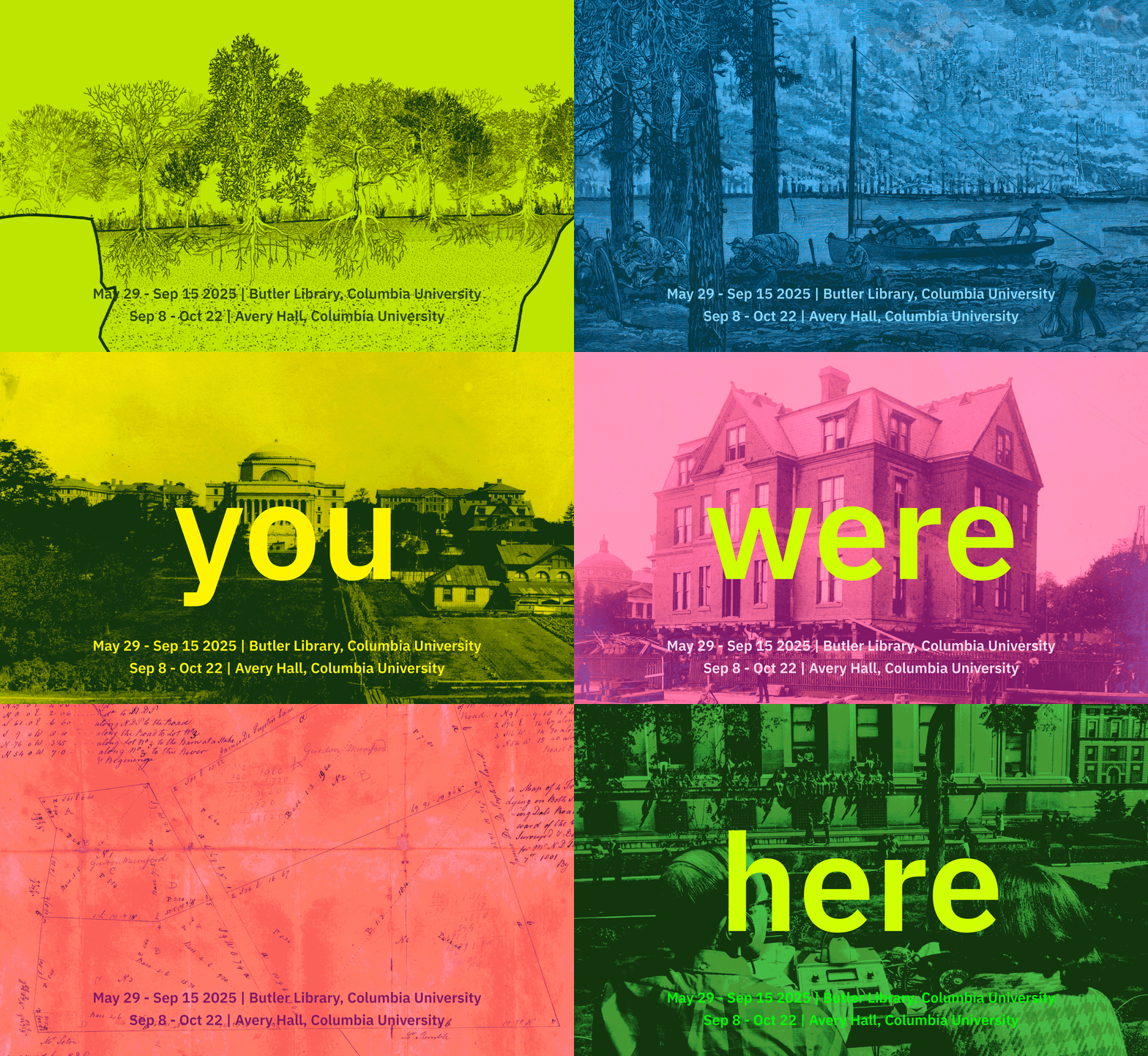
A campus, contrary to all appearances, is not a singular, bounded place. This exhibition offers an architectural history of Columbia’s campus’s land, as told from Buell Hall, its oldest surviving building. Predating the university’s arrival, this “villa” was built as an experimental pavilion for an “insane asylum” 140 years ago, at a moment when diseases were newly thought to be genetic and mental health worthy of dedicated hospitals. Research into this small building’s history – why it was built, how it was relocated, what changes in the land accompanied its survival – has uncovered a trove of lessons about architecture, bedrock, plants, and property, revealing a dynamic that extends far beyond the building’s modest footprint and the institution’s neat perimeter. 

This deep history of land-shaping events is exhibited in eight vitrines. First and foremost, they cast doubt on the clichéd notion that campuses are “master-planned” once and remain complete forever. The vitrines proceed in roughly chronological order, but also revisit patterns and themes, exploring the inventive and sometimes forceful ways land and architecture are leveraged to suit changing human uses. 

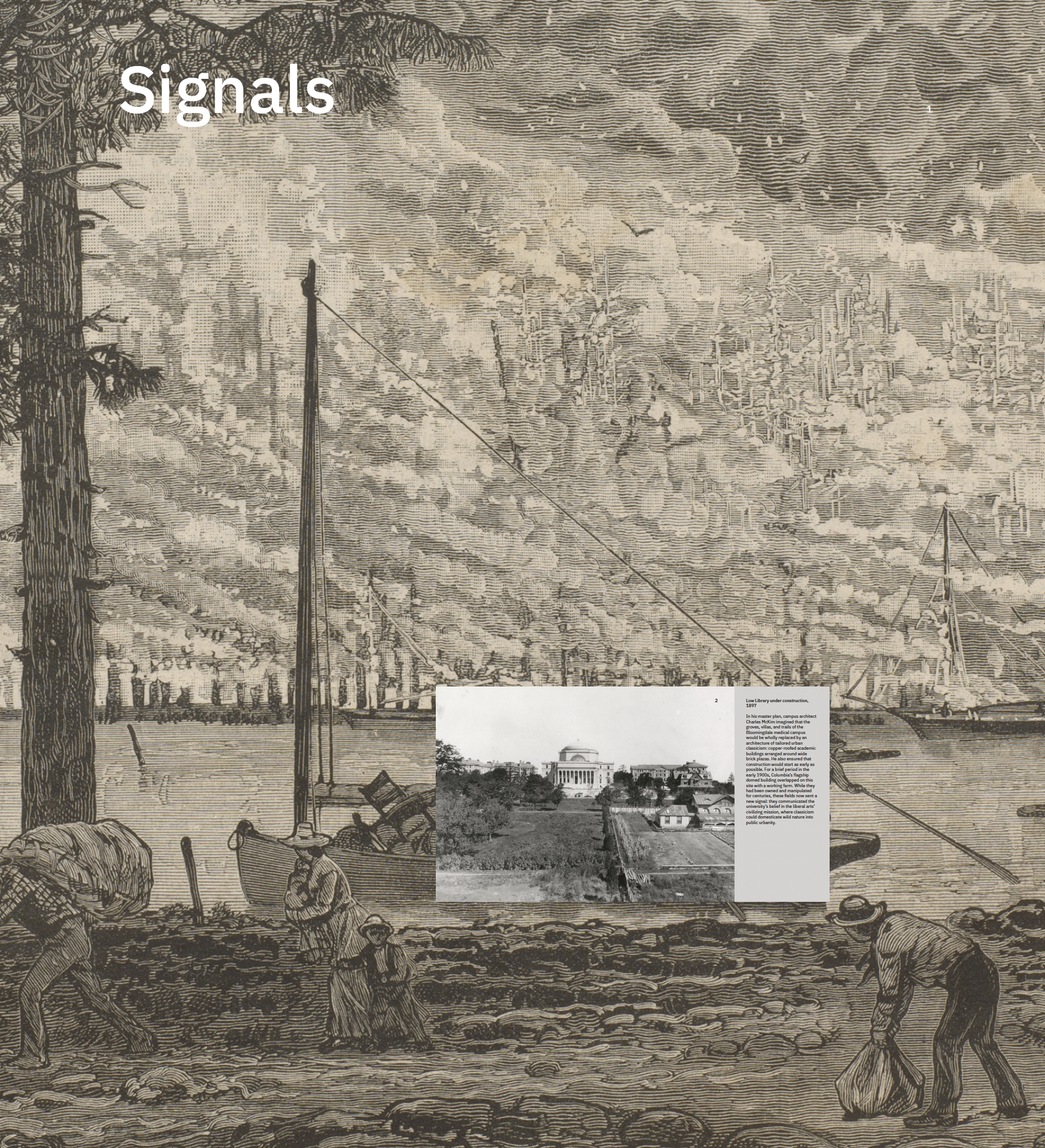
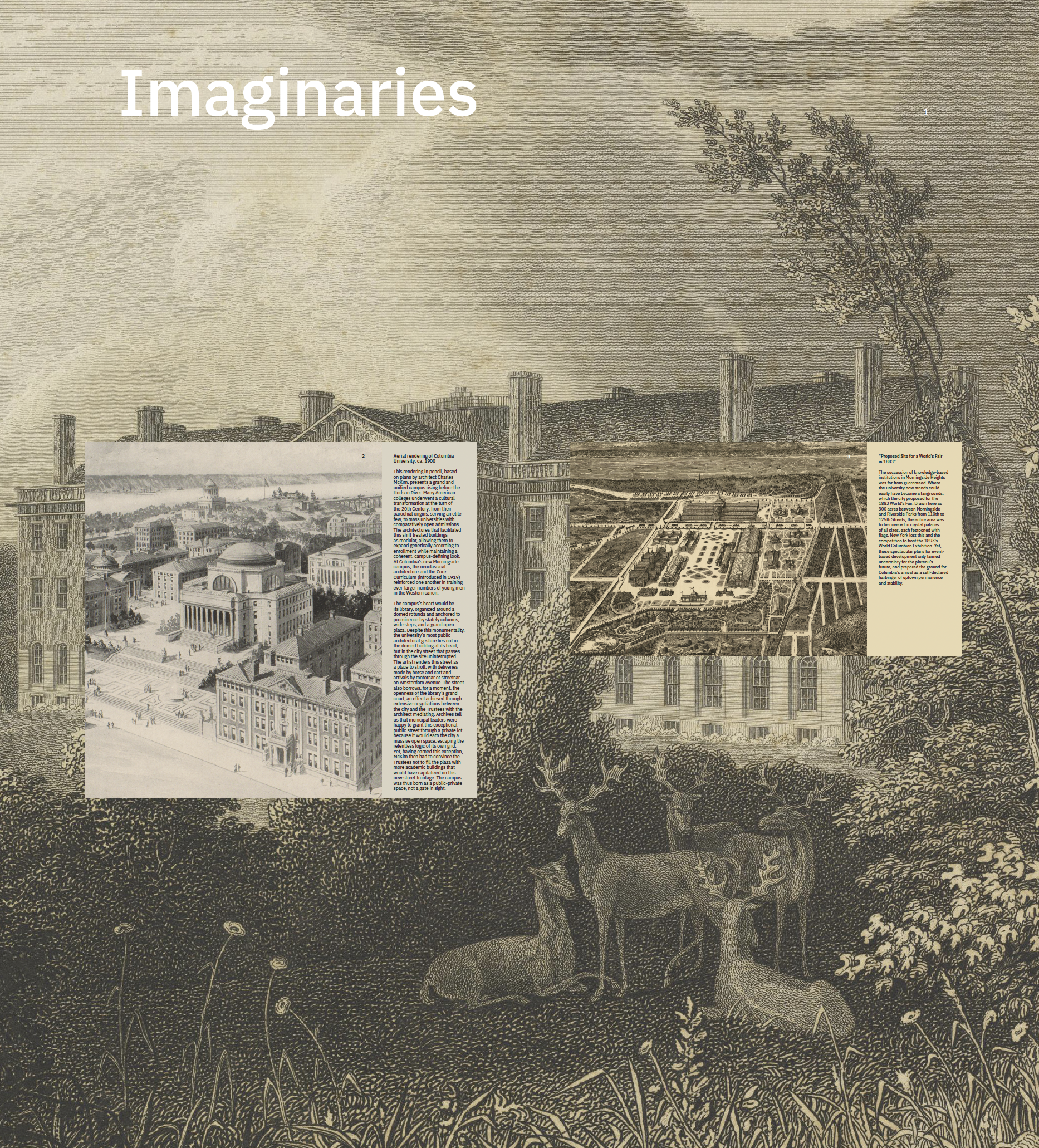
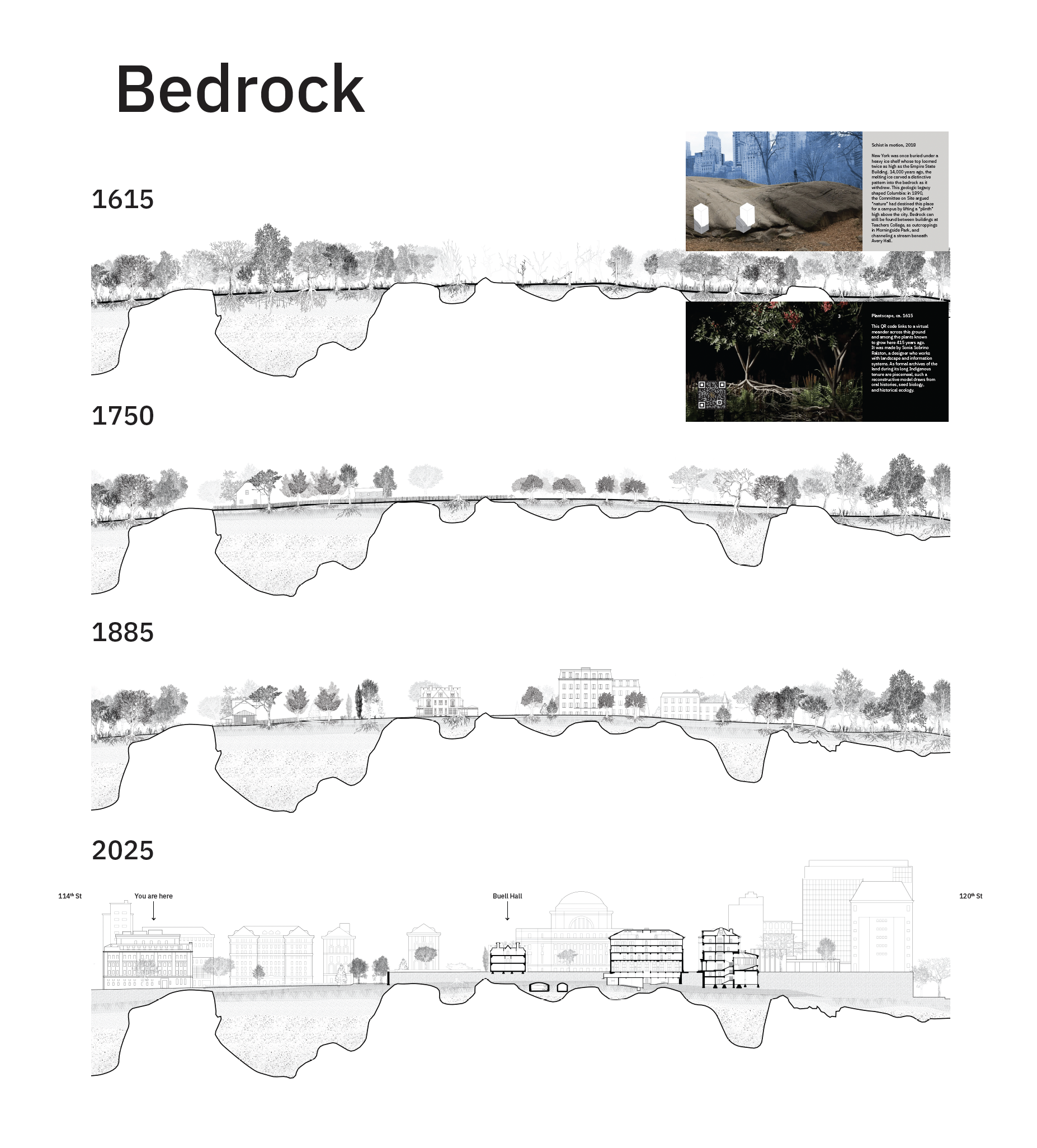
The story begins with Bedrock and its shaping of life above ground. Before any building, there are Signals of settlement or movement; this vitrine recognizes the power of a hilltop to call attention, beginning with Morningside Heights’ long Indigenous land tenure and on to a succession of new uses and names. Once institutions make formal plans to build, they advertise their relationships to nature and the city through architectural Imaginaries.

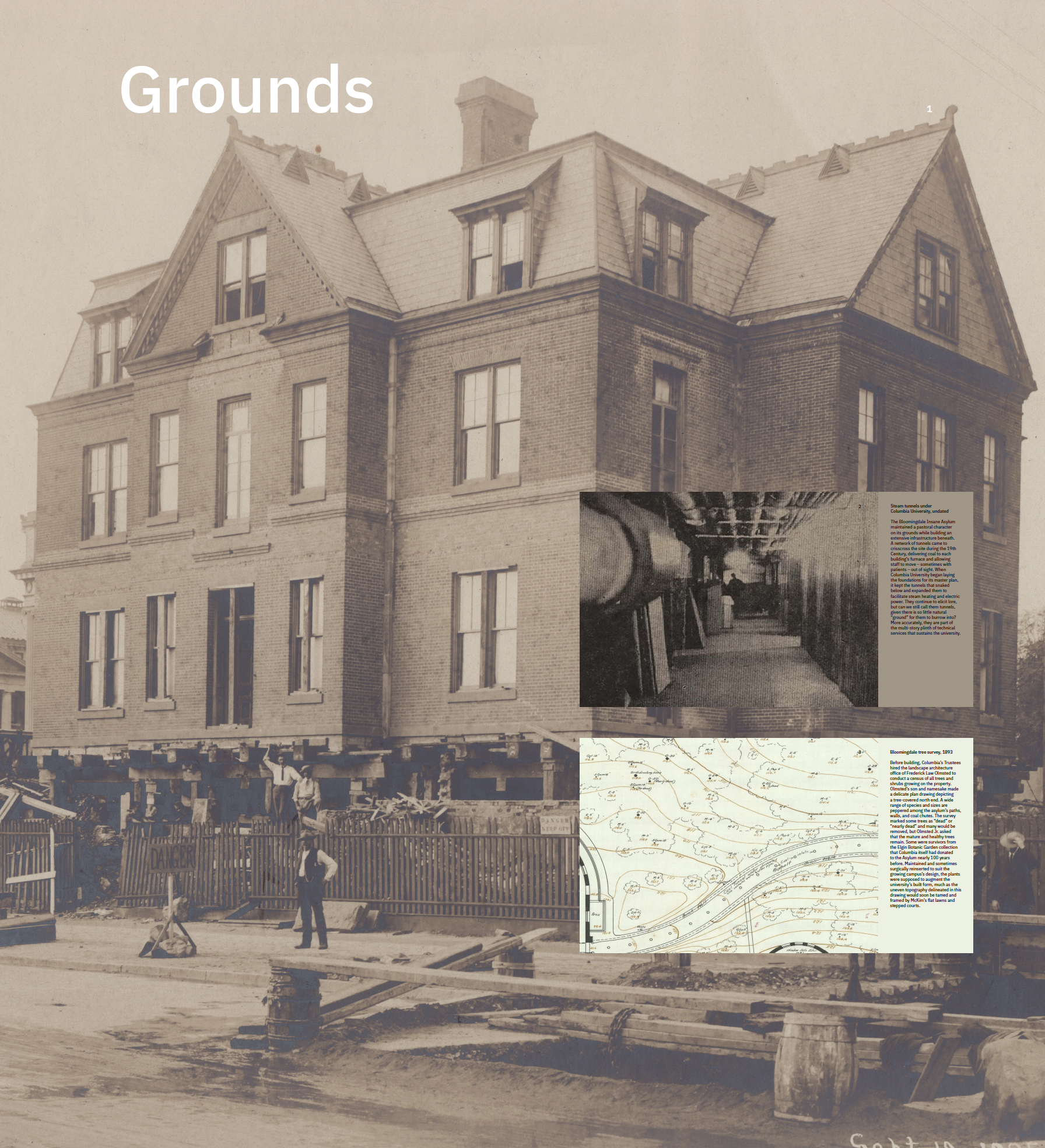
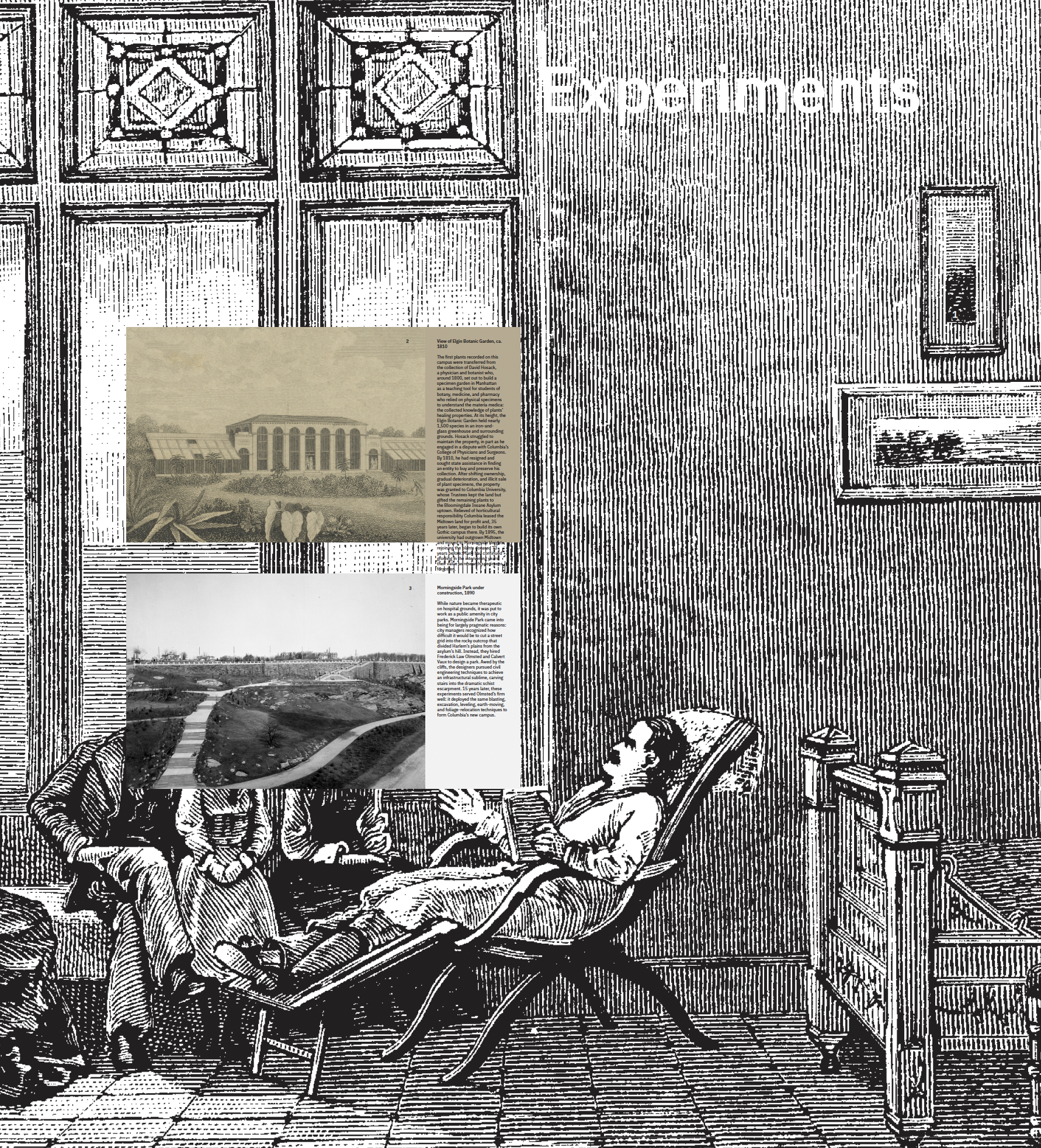
Holdings is the first vitrine to feature Columbia’s discrete ownership of this land. The school expanded over three centuries – from a single land grant to an international property portfolio – by marching northward from Lower Manhattan to Upstate New York and beyond. Experiments reflects on the medical and topographical innovations that have inflected institutional missions and identities here. In Grounds, we observe the technologies invented to pack forms of academic life tightly together, despite stubborn physical obstacles. Finally, in Occupants, we visit the gatherings foiled or enabled by buildings, often temporary but affecting the mood long after they depart.

This exhibition was conceived and curated over three years by student, staff, and faculty researchers at the Temple Hoyne Buell Center for the Study of American Architecture, currently housed in Buell Hall.

Credits

Buell Center: Lucia Allais, Director; Elsa MH Mäki, Assistant Director;  Michelle Huynh Chu, Program Manager

Exhibition concept, research, design: Lucia Allais, Ultan Byrne, Andrew Chee, Michelle Huynh Chu, Omar Ismail, Spenser Krut, Elsa MH Mäki, Amora McConnell, Jacob Moore, Clarisse Figueiredo de Queiroz, Yara Saqfalhait, Jordan Steingard, Paula Volpato, Xueyuan Wang, Catherine Weilein, Stephen Zimmerer 

Section drawings: Omar Ismail and team

Digital landscape model: Sonia Sobrino Ralston

Special thanks: Aleksandr Bierig, Kaoukab Chebaro, Andrew Dolkart, Marguerite Holloway, Maura Lucking, Bill Menke, Joanna Rios, Don Schlosser, Kendra Sykes, Mika Tal, Jocelyn Wilk, Avery Library, Rare Book and Manuscript Library, New York Botanical Garden


Image

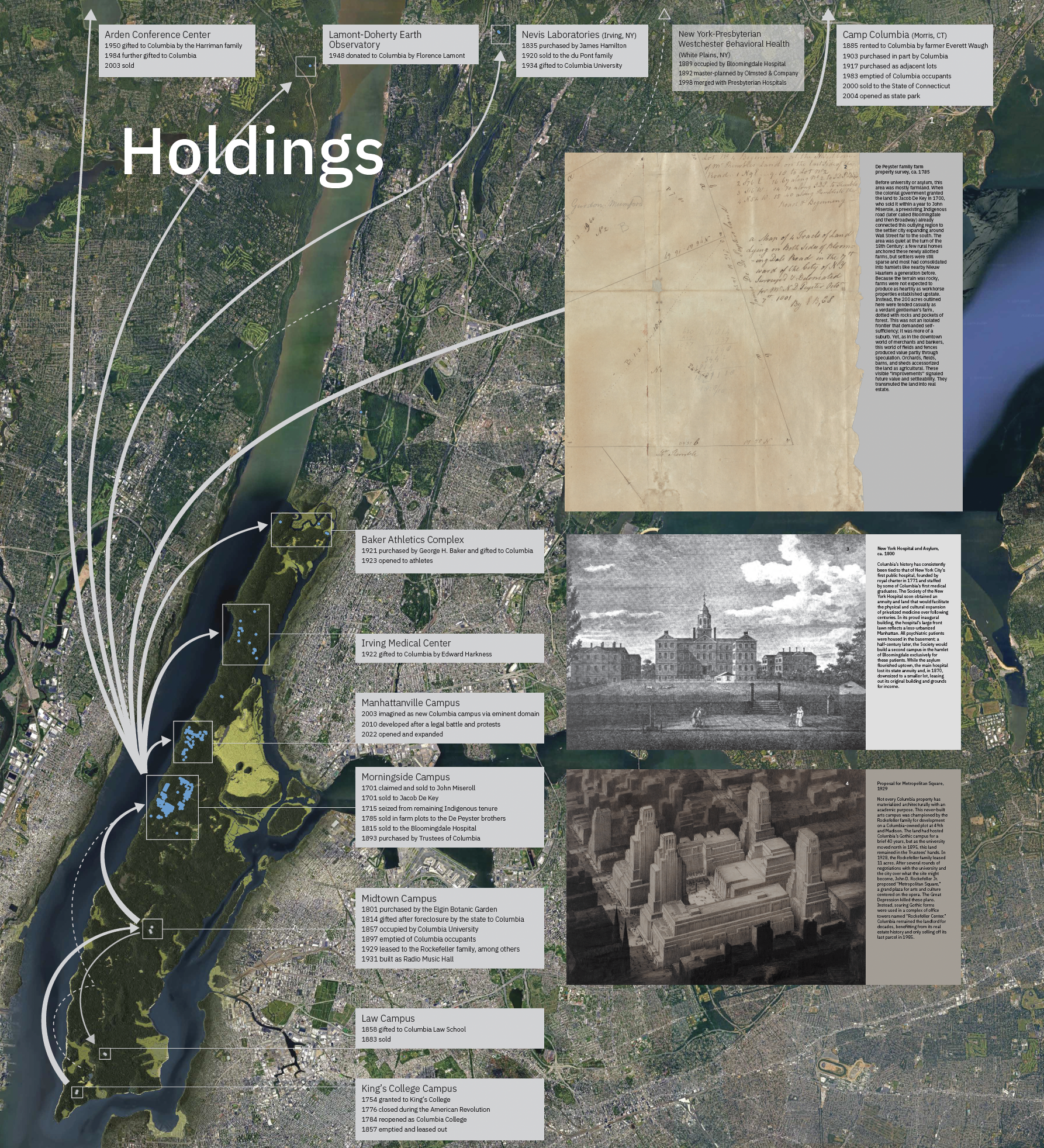
Buell Center: Paula Volpato and Amora McConnell, “Columbia land holdings atop Manahatta, 1754-2025” (diagram, 2025) on illustration by Markley Boyer and Eric W. Sanderson, Wildlife Conservation Society (2009), image courtesy New York Botanical Garden


Holdings

Since its 1754 founding as King’s College, teaching its first classes in the vestry of Trinity Church in Lower Manhattan, Columbia University has consistently moved its facilities northward. Its land holdings have followed waves of speculation and the trajectory of other institutions, especially medical ones. This vitrine illustrates Columbia’s intricate history of real estate transactions, which occurred in roughly two phases: 150 years of expansion and site-hopping abreast of urbanization and densification, followed by 125 years wherein permanence on one site paradoxically allowed the university to diversify its holdings, branching out as a regional, then international, network.
After New York was colonized in the 1600s, small settlements grew together over the centuries, built up by the labor of immigrants, enslaved, self-emancipated, Indigenous, and free peoples. Institutions formed in the gaps. They relied upon land grants from the crown or state, levying these gifts into durable, if scattered, land holdings. Nascent institutions proved both enduring and surprisingly mobile. Early in the 18th Century, Columbia’s fate became entwined with that of New York’s first public hospital through their shared research, faculty, and alumni. The two were paired in an elaborate and consistent dance of real estate sales and purchases throughout the 19th Century. 

A turning point came around 1900, as Columbia invested in a main campus at Morningside Heights. From this semi-urban seat, and neighbored by growing institutions, Columbia’s land acquisitions soon multiplied. These included large plots in Northern Manhattan for a medical center and an athletic complex. The university purchased farmland in Northwest Connecticut, used for almost a century as grounds for summer camps, military training, and hunting, before it sold them back to the state as a park. Land gifts from the families of alumni followed, bestowing plots for laboratories, observatories, and think-tanks. After World War II, much of the city fabric around Harlem became Columbia-owned housing. In 2003, the Manhattanville Campus was born by eminent domain. Columbia hosts Global Centers in 11 countries. Morningside is the anchor from which the institution first defined itself as extending outwards.


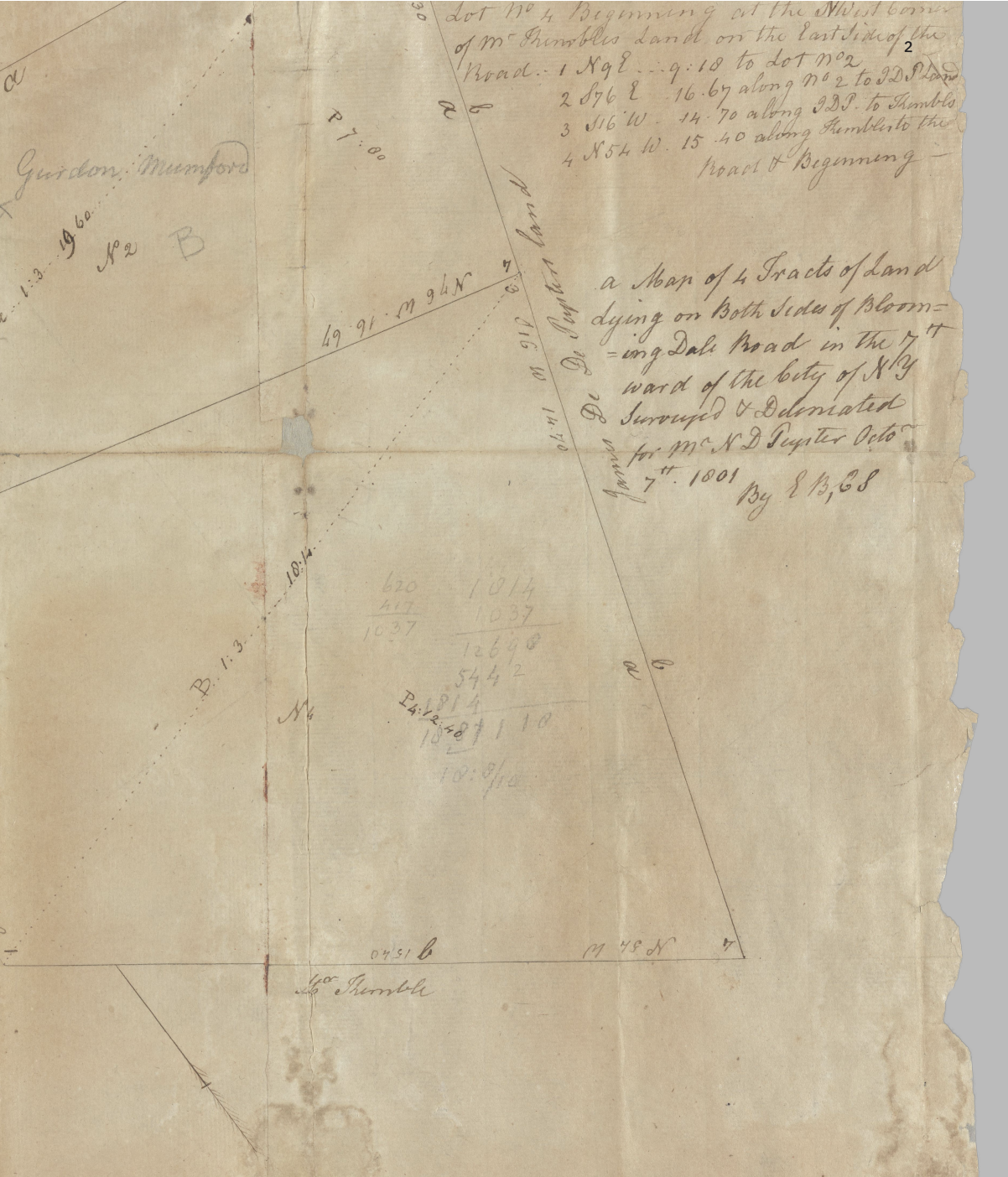
Property survey, De Peyster family farm, ca. 1785

Image

"N. De Peyster's four lots of land at Bloomingdale" (ca. 1785), New York Public Library

Before university or asylum, this area was mostly farmland. When the colonial government granted the land to John Miseroll in 1700 – who sold it within a year to Jacob De Key – a preexisting Indigenous road (later called Bloomingdale and then Broadway) already connected this outlying region to the settler city expanding around Wall Street far to the south. 

The area was quiet at the turn of the 18th Century: a few rural homes anchored these newly allotted farms, but settlers were still sparse and most had consolidated into hamlets like nearby Nieuw Haarlem a generation before. Because the terrain was rocky, farms were not expected to produce as heartily as workhorse properties established upstate.

Instead, the 200 acres outlined here were tended casually as a verdant gentleman’s farm, dotted with rocks and pockets of forest. This was not an isolated frontier that demanded self-sufficiency; it was more of a suburb. Yet, as in the downtown world of merchants and bankers, this world of fields and fences produced value partly through speculation. Orchards, fields, barns, and sheds accessorized the land as agricultural. These visible “improvements” signaled future value and settleability, turning land into real estate.


New York Hospital and Asylum, ca. 1800

Image

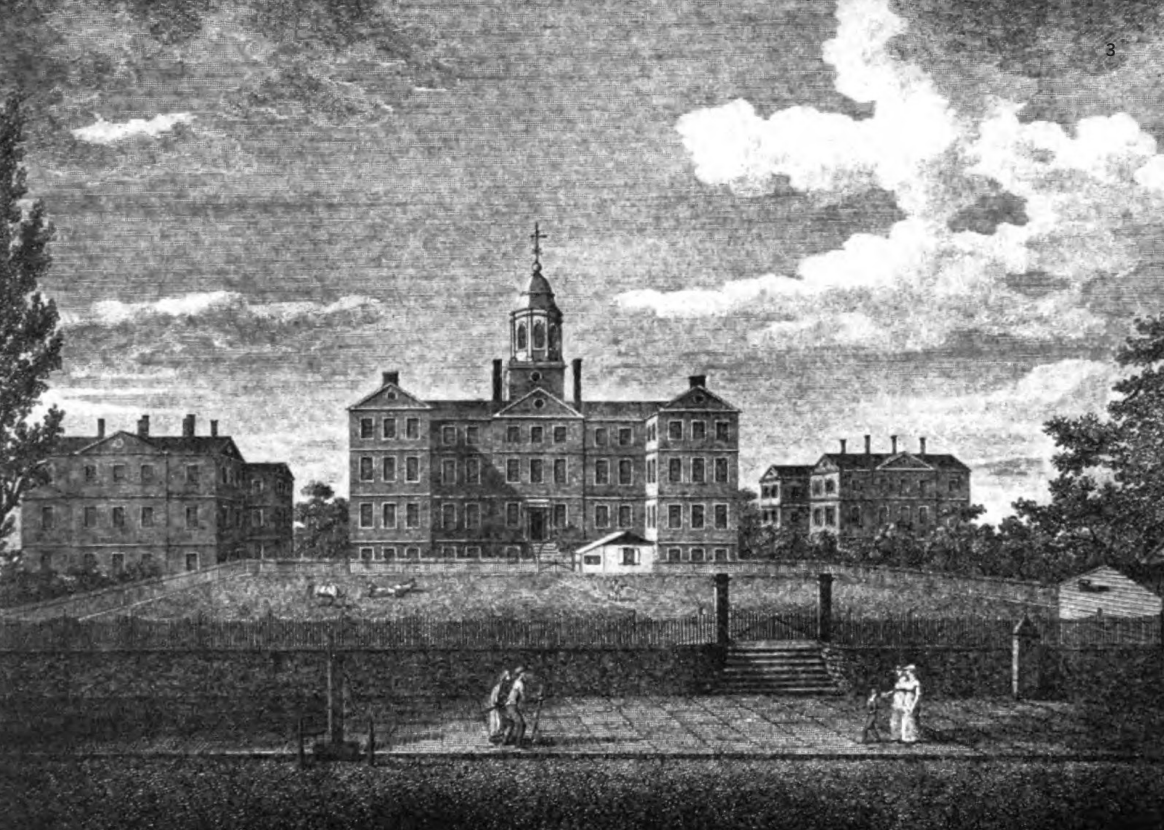
“New York Hospital and Asylum” (ca. 1800), print in Society of the New York Hospital report (1912), Columbia University Libraries

Columbia’s history has consistently been tied to that of New York City’s first public hospital, founded by royal charter in 1771 and staffed by some of Columbia’s first medical graduates. The Society of the New York Hospital soon obtained an annuity and land that would facilitate the physical and cultural expansion of privatized medicine over following centuries.

In its proud inaugural building, the hospital’s large front lawn reflects a less-urbanized Manhattan. All psychiatric patients were housed in the basement; a half-century later, the Society would build a second campus in the hamlet of Bloomingdale exclusively for these patients. While the asylum flourished uptown, the main hospital lost its state annuity and, in 1870, downsized to a smaller lot, leasing out its original building and grounds for income.


Proposal for Metropolitan Square, 1929

Image

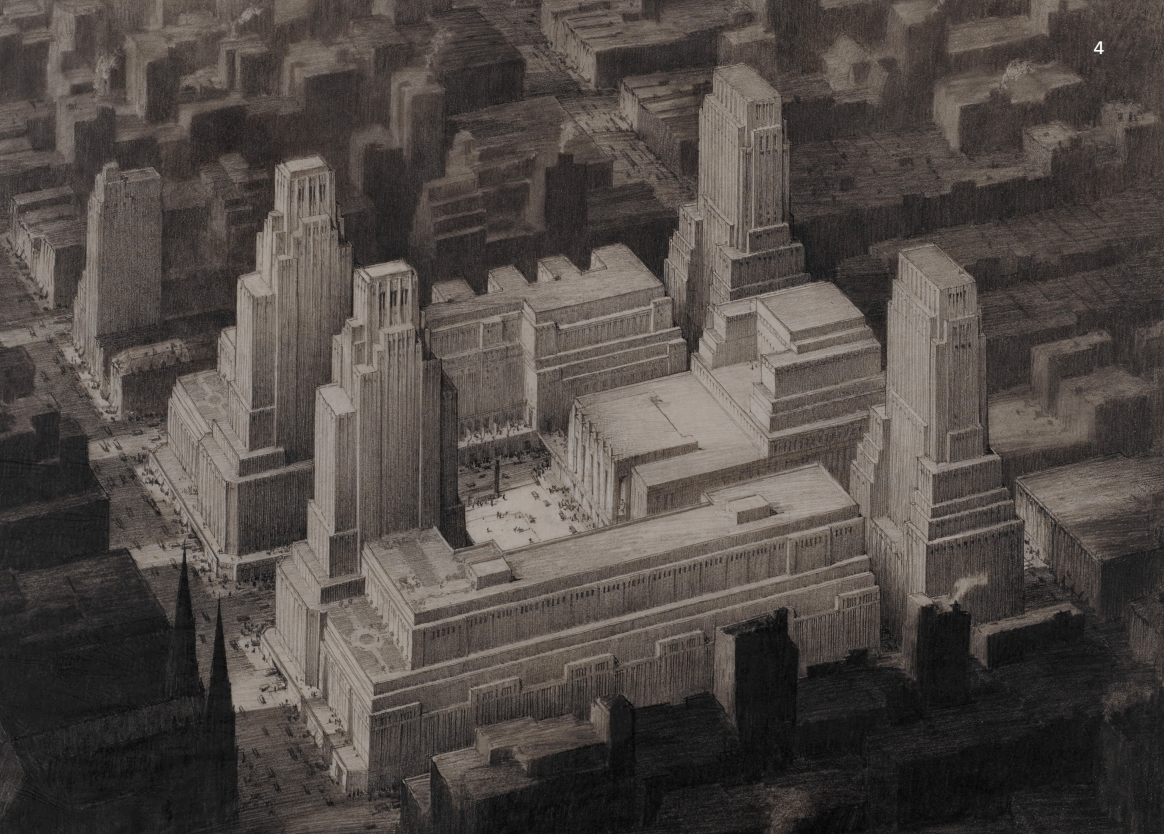
Benjamin Wistar Morris, “Suggestion of Metropolitan Square Development in harmony with proposed Metropolitan Opera House, 1929,” Avery Library

Not every Columbia property has materialized architecturally with an academic purpose. This never-built arts campus was championed by the Rockefeller family for development on a Columbia-owned plot at 49th and Madison. The land had hosted Columbia’s Gothic campus for a brief 40 years, but as the university moved north in 1895, this land remained in the trustees’ hands. In 1928, the Rockefeller family leased 11 acres. After several rounds of negotiations with the university and the city over what the site might become, John D. Rockefeller Jr. proposed “Metropolitan Square,” a grand plaza for arts and culture centered on the opera. 

The Great Depression killed these plans. Instead, soaring Gothic forms were used in a complex of office towers named “Rockefeller Center.” Columbia remained the landlord for decades, benefitting from its real estate history and only selling off its last parcel in 1985.