The biennial Dissertation Colloquium brings together a select group of doctoral students from diverse institutional and disciplinary backgrounds working on dissertation topics related to the history, theory, and criticism of American architecture, urbanism, and landscape. 

The Buell Conference on the History of Architecture brings together scholars in architectural and urban history to discuss topics in architecture, urbanism, and modernity as broadly understood.

Before you were here
Image


A history of the campus’s land told from its oldest surviving building

A campus, contrary to all appearances, is not a singular, bounded place. This exhibition offers an architectural history of Columbia’s campus’s land, as told from Buell Hall, its oldest surviving building. Predating the university’s arrival, this “villa” was built as an experimental pavilion for an “insane asylum” 140 years ago, at a moment when diseases were newly thought to be genetic and mental health worthy of dedicated hospitals. Research into this small building’s history – why it was built, how it was relocated, what changes in the land accompanied its survival – has uncovered a trove of lessons about architecture, bedrock, plants, and property, revealing a dynamic that extends far beyond the building’s modest footprint and the institution’s neat perimeter. 

This deep history of land-shaping events is exhibited in eight vitrines. First and foremost, they cast doubt on the clichéd notion that campuses are “master-planned” once and remain complete forever. The vitrines proceed in roughly chronological order, but also revisit patterns and themes, exploring the inventive and sometimes forceful ways land and architecture are leveraged to suit changing human uses. 

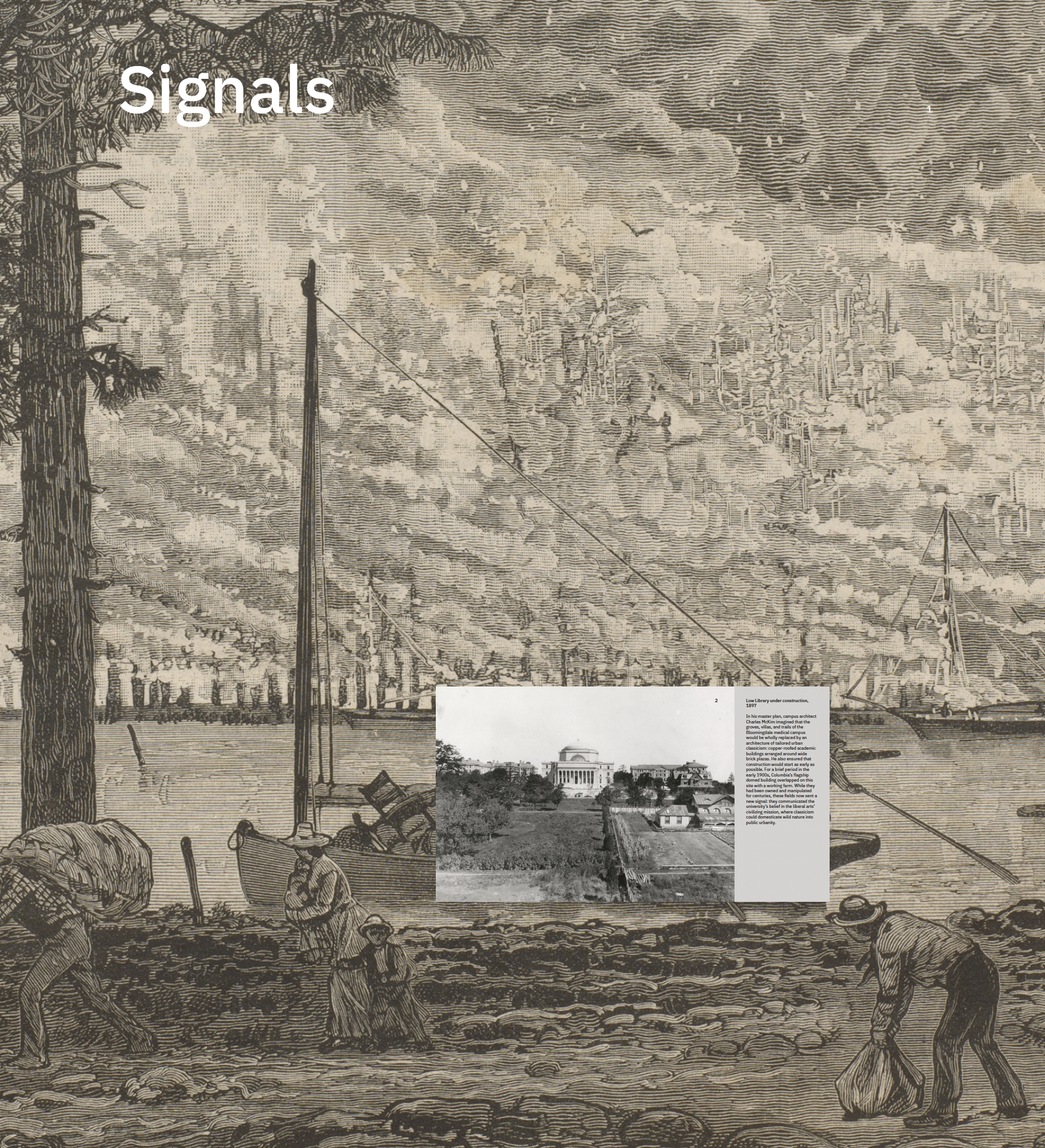
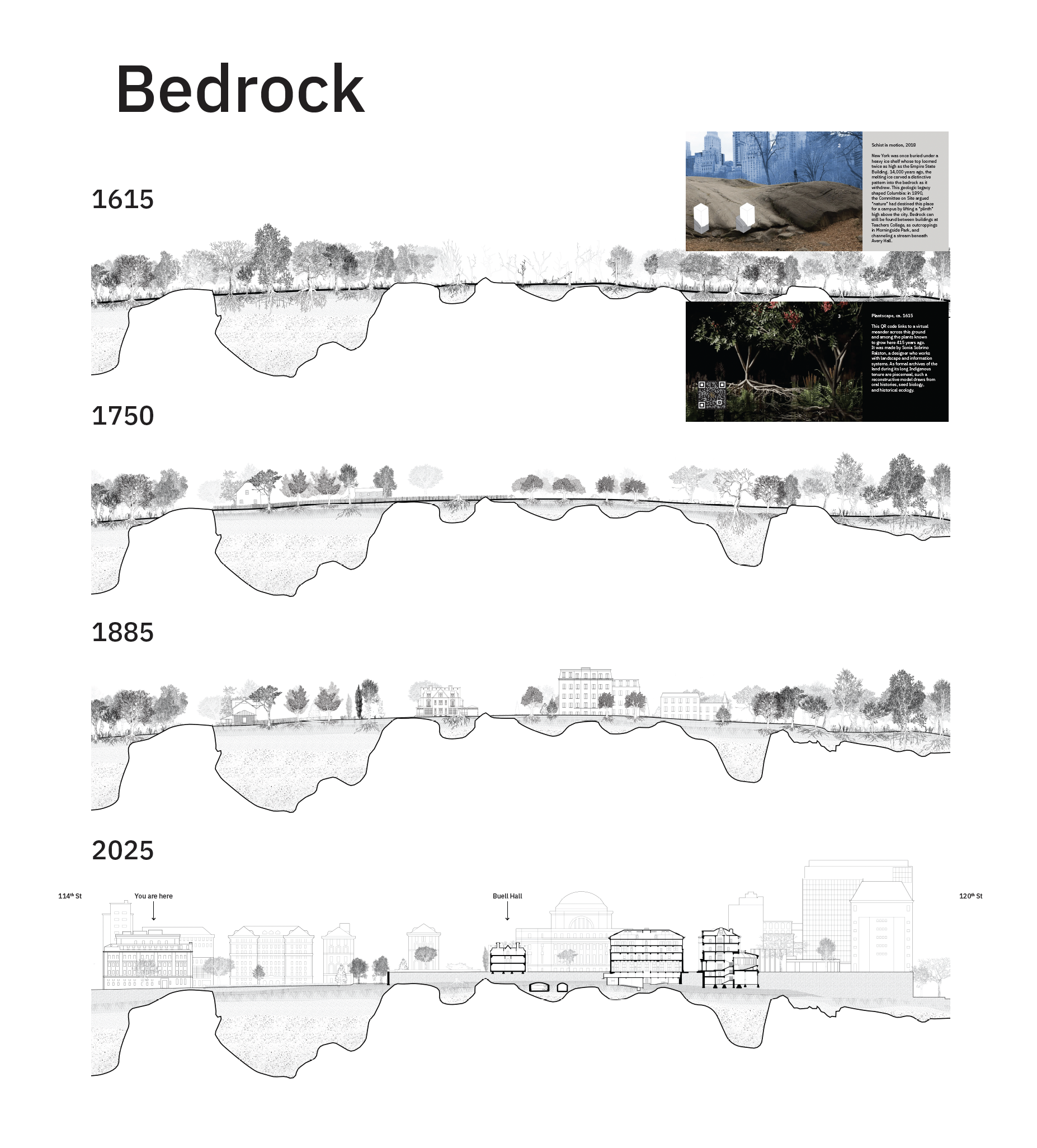
The story begins with Bedrock and its shaping of life above ground. Before any building, there are Signals of settlement or movement; this vitrine recognizes the power of a hilltop to call attention, beginning with Morningside Heights’ long Indigenous land tenure and on to a succession of new uses and names. Once institutions make formal plans to build, they advertise their relationships to nature and the city through architectural Imaginaries.

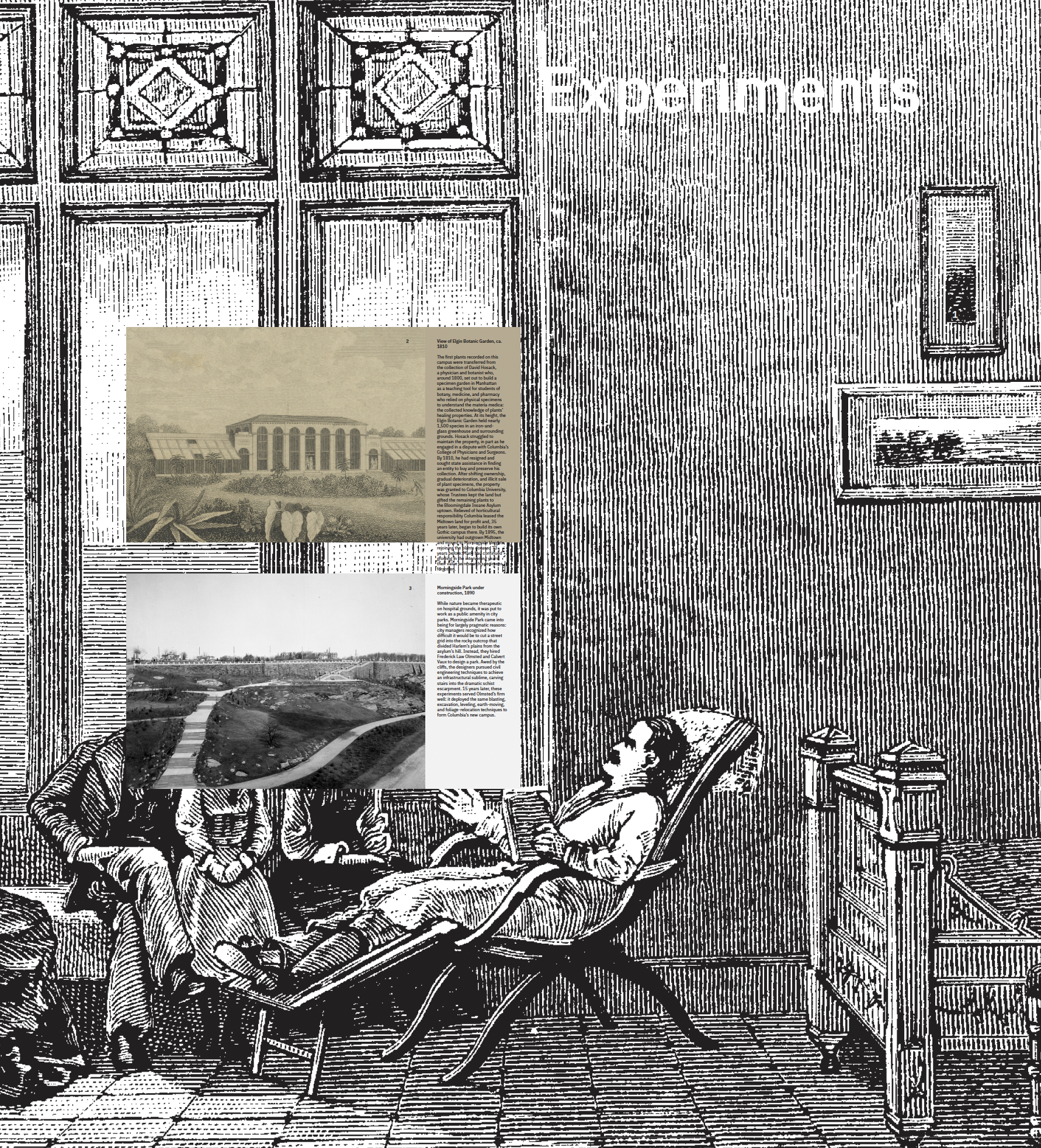
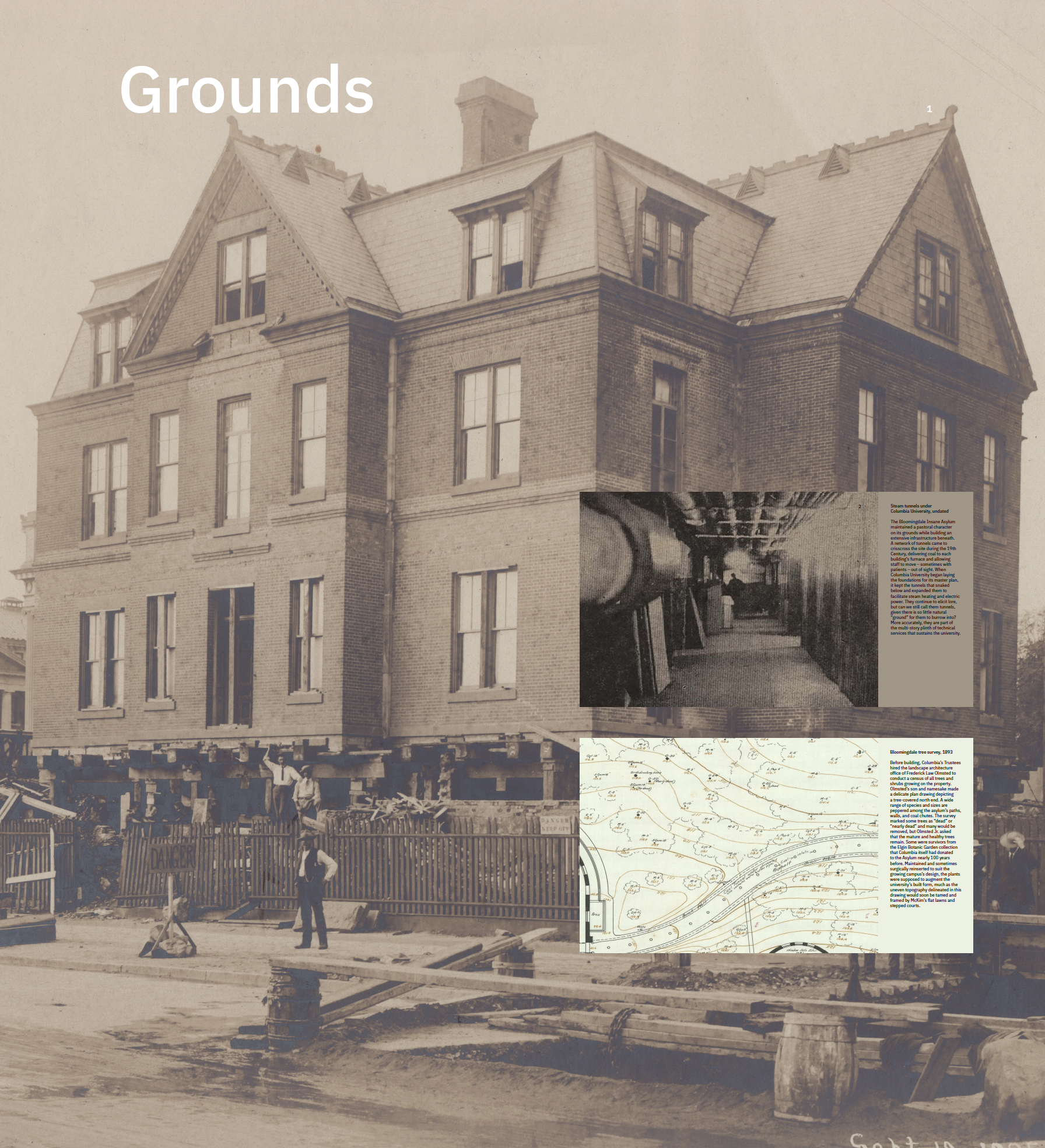
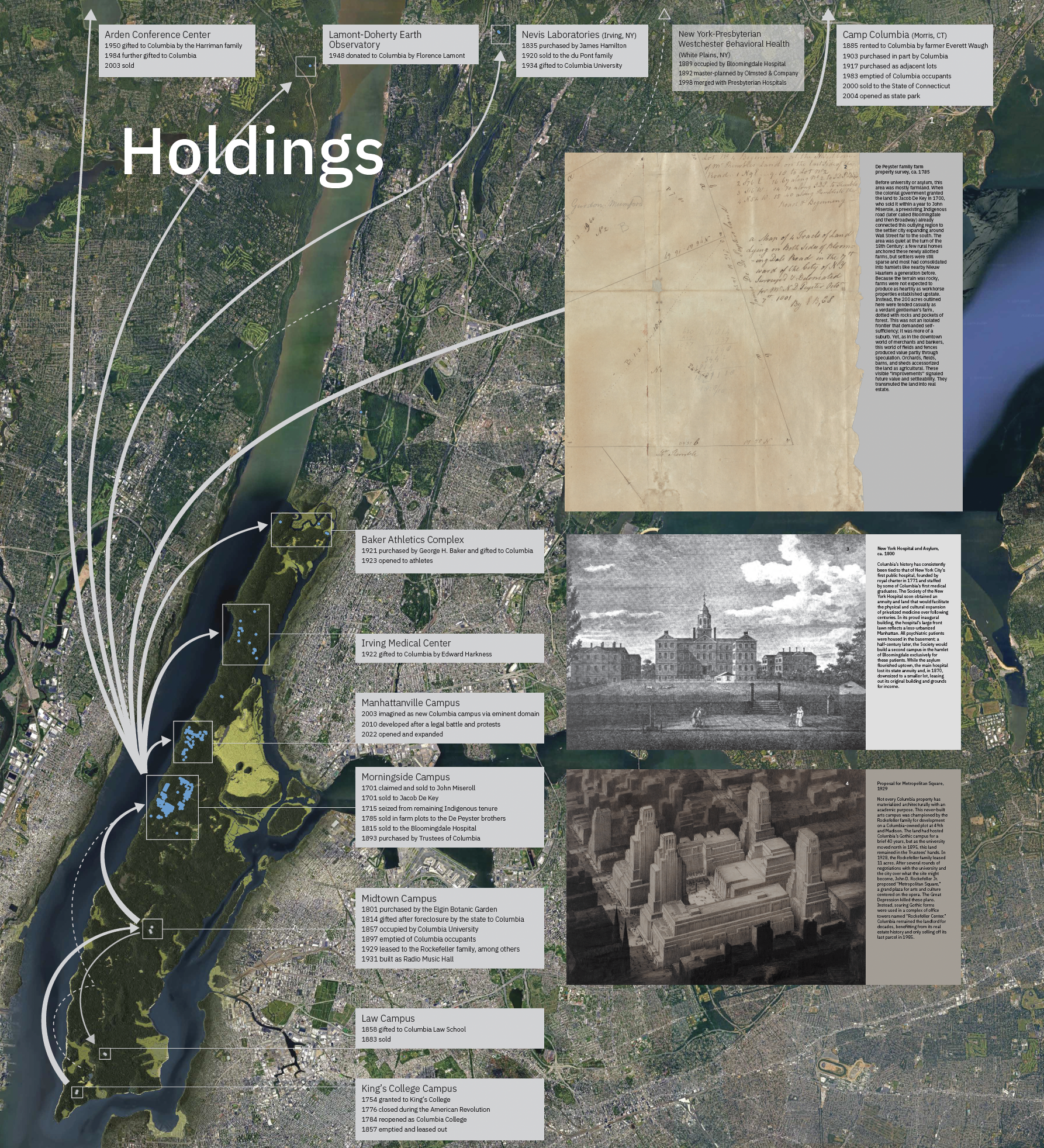
Holdings is the first vitrine to feature Columbia’s discrete ownership of this land. The school expanded over three centuries – from a single land grant to an international property portfolio – by marching northward from Lower Manhattan to Upstate New York and beyond. Experiments reflects on the medical and topographical innovations that have inflected institutional missions and identities here. In Grounds, we observe the technologies invented to pack forms of academic life tightly together, despite stubborn physical obstacles. Finally, in Occupants, we visit the gatherings foiled or enabled by buildings, often temporary but affecting the mood long after they depart.

This exhibition was conceived and curated over three years by student, staff, and faculty researchers at the Temple Hoyne Buell Center for the Study of American Architecture, currently housed in Buell Hall.

Credits

Buell Center: Lucia Allais, Director; Elsa MH Mäki, Assistant Director;  Michelle Huynh Chu, Program Manager

Exhibition concept, research, design: Lucia Allais, Ultan Byrne, Andrew Chee, Michelle Huynh Chu, Omar Ismail, Spenser Krut, Elsa MH Mäki, Amora McConnell, Jacob Moore, Clarisse Figueiredo de Queiroz, Yara Saqfalhait, Jordan Steingard, Paula Volpato, Xueyuan Wang, Catherine Weilein, Stephen Zimmerer 

Section drawings: Omar Ismail and team

Digital landscape model: Sonia Sobrino Ralston

Special thanks: Aleksandr Bierig, Kaoukab Chebaro, Andrew Dolkart, Marguerite Holloway, Maura Lucking, Bill Menke, Joanna Rios, Don Schlosser, Kendra Sykes, Mika Tal, Jocelyn Wilk, Avery Library, Rare Book and Manuscript Library, New York Botanical Garden
 

Image

Robert Weir, “Lunatic Asylum New York,” New York Mirror (183)


Imaginaries

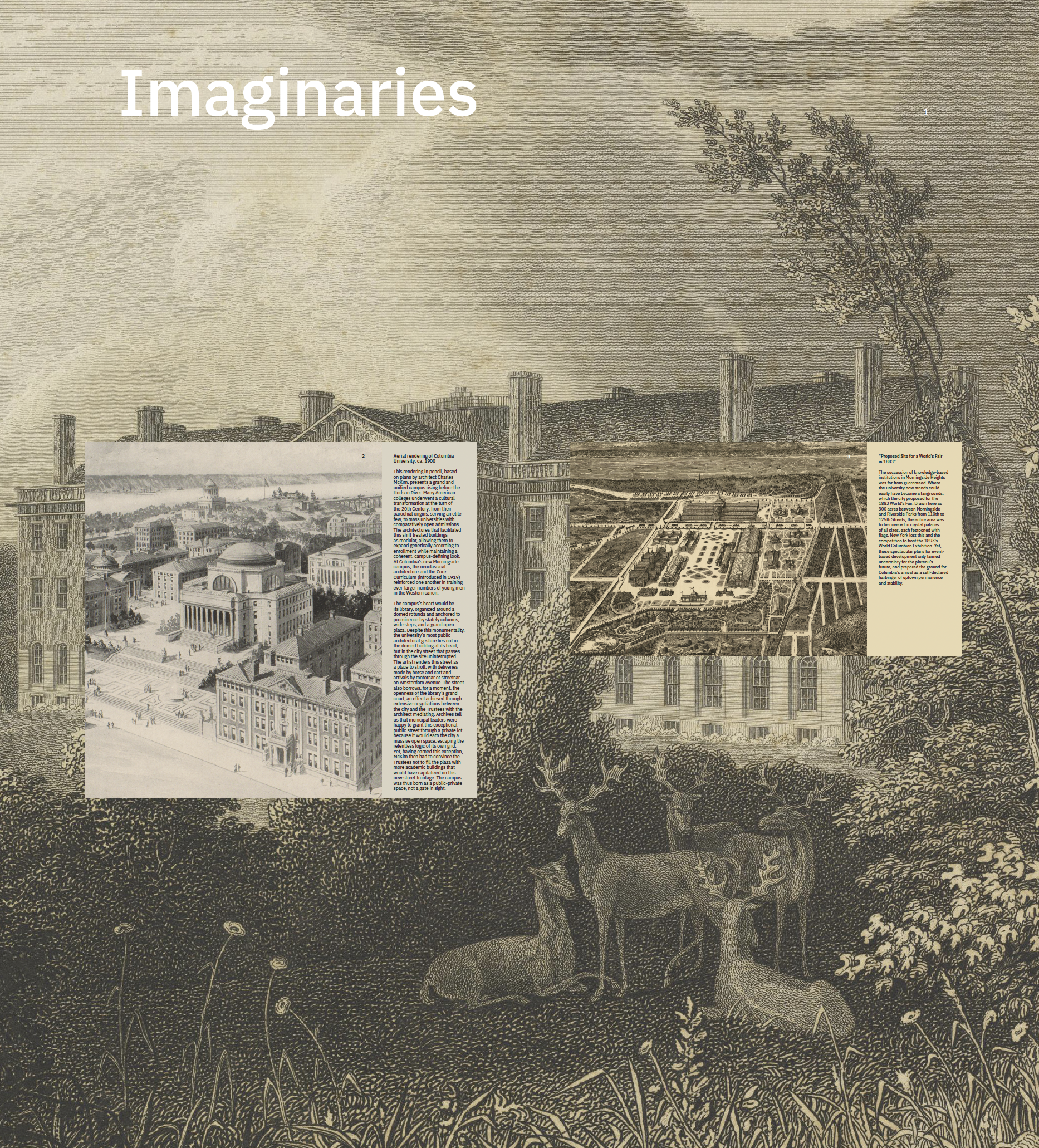
The first architecture designed to give this site a deliberate public image arrived in the early 19th Century. Since then, any building proposal has required a public visualization to earn legitimacy before construction. Innumerable lavish imaginaries determine the course of development, even when they remain unbuilt. 
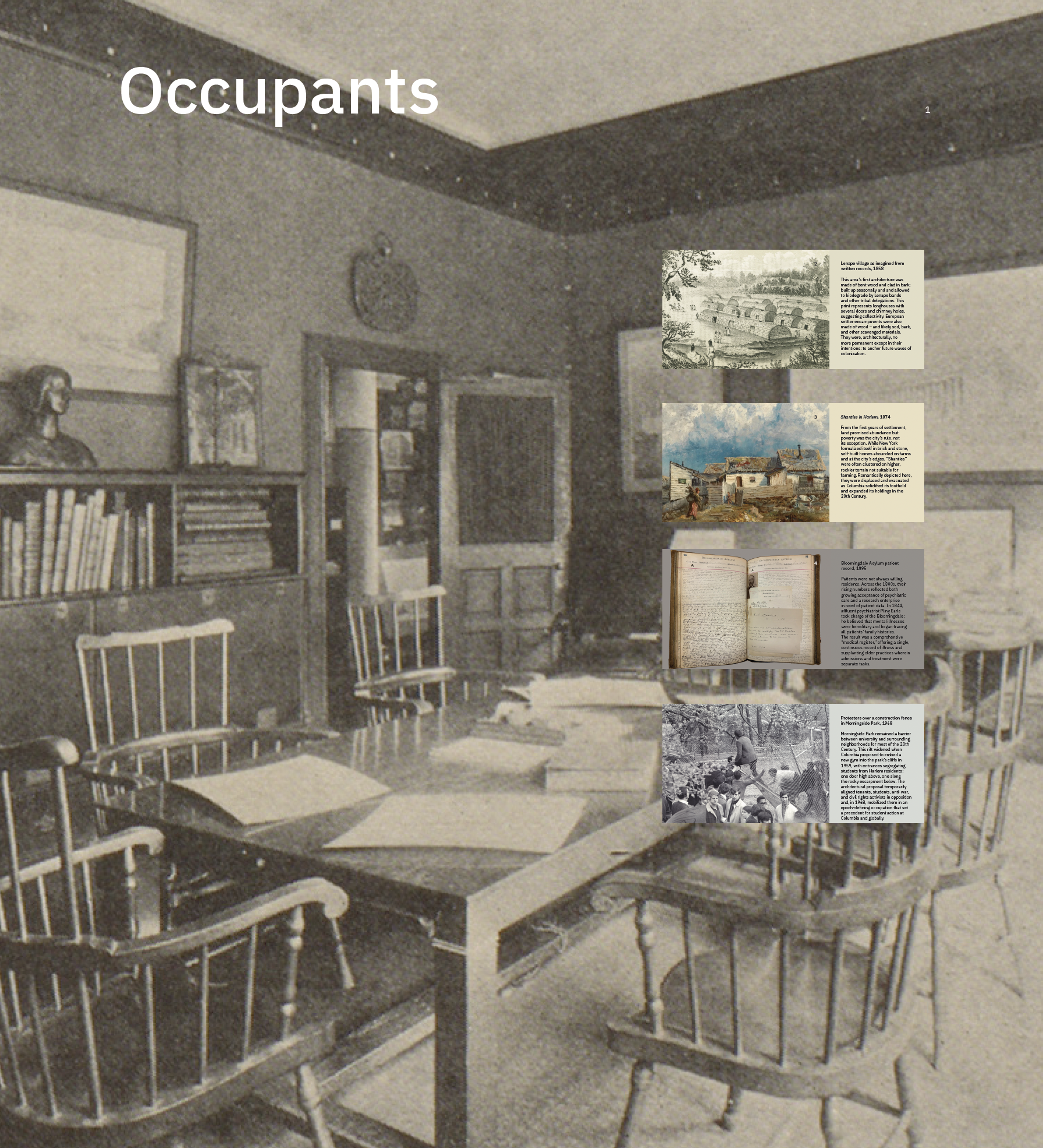
When Columbia purchased land here in the 1890s, it acquired not an empty lot but a densely cultivated campus of trees, lawns, gardens, tunnels, and a network of medical buildings. The Bloomingdale Insane Asylum had been the first organization to consolidate 80 acres of private farmland here by 1818, and to transform it over eight decades into an image of institutional idyll. 

The Asylum originated in a rising movement for dedicated mental health treatment. Advocates viewed exposure to nature as a precondition for health, and stand-alone buildings in manicured, pastoral grounds as critical to the advancement of medical science. They set plans in motion for the New York Hospital’s “country annex” miles from Manhattan’s urban center, and construction on the main treatment center began in 1821.1 Bloomingdale was already a semi-rural neighborhood dotted with shanties, taverns, a country house or two. The property was loosely cultivated around stone outcroppings and patches of old-growth Indigenous forest. 

The site’s past use as a gentleman’s farm made it especially suitable for this new kind of hospital, and for a new science of heredity. The land’s agricultural potential was well-suited to theories of the day: that physical labor held restorative potential and built moral character. Throughout the century, the Bloomingdale maintained a portion of existing farmland and integrated outdoor labor into its daily operations. Patients were put to work gathering crops, cultivating ornamental gardens and greenhouses inherited from the Elgin Botanic Garden, and tending a grove of trees. Their labor was their treatment. With them, the meaning of “improvement” evolved from the creation of productive land to the rehabilitation of persons into productive citizens. An image of health thus emanated from Bloomingdale: aesthetics and agriculture together displaying the private institution as a public “good.” 


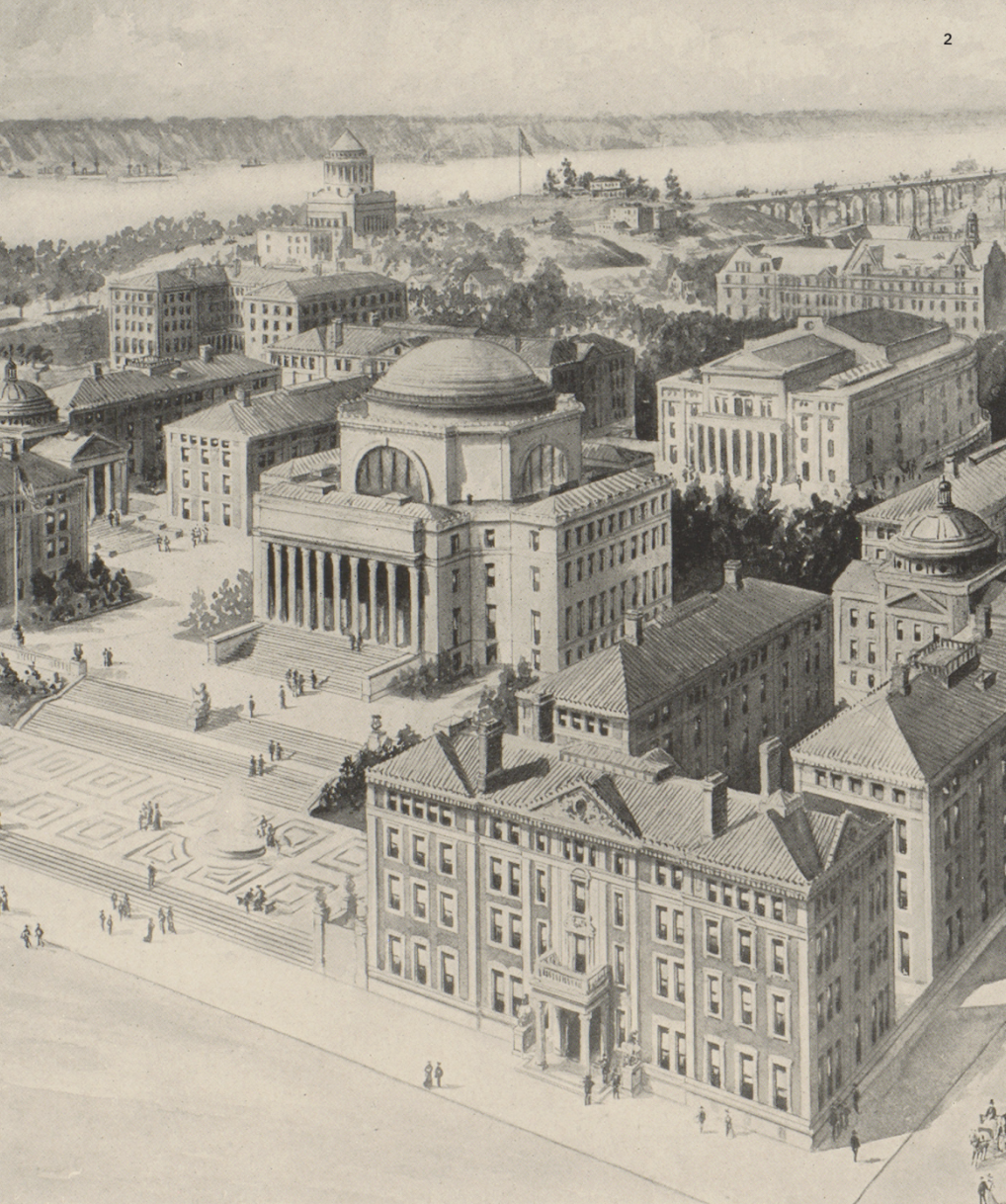
Aerial rendering of proposed Columbia campus, 1906

Image

H.M. Pettit, Illustration in King’s Views of New York (1906), Seymour B. Durst Old York Library, Avery Library

This pencil rendering, based on Charles McKim’s plans, presents a grand and unified campus rising before the Hudson River. Many American colleges transformed at the turn of the 20th Century: from their parochial origins, serving an elite few, to mass universities with comparatively open admissions. The architectures that facilitated this shift treated buildings as modular, allowing them to expand according to enrollment while maintaining a coherent, campus-defining look. At Columbia’s new uptown campus, the neoclassical architecture and the Core Curriculum (introduced in 1919) reinforced one another in training ever-larger numbers of young men in the Western canon. The campus’s heart would be its library, organized around a domed rotunda and anchored to prominence by stately columns, wide steps, and a grand open plaza. 

Despite this monumentality, the university’s most public architectural gesture lies not in the domed building at its heart, but in the city street that passes through the site uninterrupted. The artist renders this street as a place to stroll, with deliveries made by horse and cart. The street also borrows, for a moment, the openness of the library’s grand court, an effect achieved through extensive negotiations between the city and the trustees, with the architect’s mediation. Archives tell us that municipal leaders were happy to grant this exceptional public street through a private lot because it would earn the city a massive open space, escaping the relentless logic of its own grid. Having secured this street frontage, McKim then had to convince the Trustees not to fill the plaza with even more academic buildings. The campus was thus born as a public-private compromise, not a gate in sight.


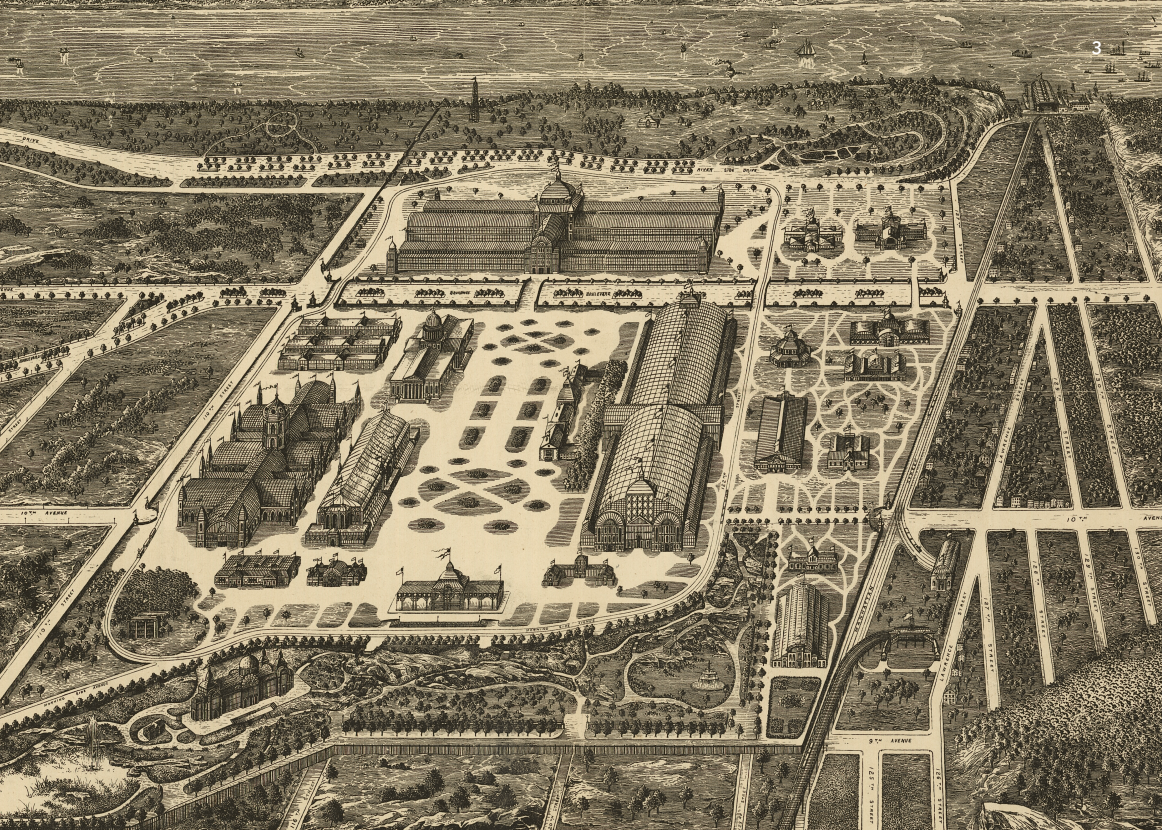
“Proposed Site for a World’s Fair in 1883”

Image

Walter Stranders, “Proposed Site for a World’s Fair in 1883,” Demorest’s Illustrated Monthly Magazine (ca. 1879), Library of Congress

In the late 19th Century, institutional succession in Morningside Heights was far from guaranteed. Where the university now stands could easily have become a fairgrounds, which the city proposed for the 1883 World’s Fair. Drawn here as 300 acres between Morningside and Riverside Parks from 110th to 125th Streets, the entire area was to be covered in crystal palaces of all sizes, each festooned with flags. New York lost this and the competition to host the 1893 World Columbian Exhibition. 

Yet, these spectacular plans for event-based development only fanned uncertainty for the plateau’s future, and prepared the ground for Columbia’s arrival as a self-declared harbinger of uptown permanence and stability.
 

    Footnotes

  • 1

    Mott, Hopper Striker, The New York of yesterday; a descriptive narrative of Old Bloomingdale. New York: Putnam's, 1908, 24.